Avoid Vendor Lock-In with Multi-Cloud Governance

Vendor lock-in can trap businesses with a single cloud provider, making migrations costly and complex. Multi-cloud governance solves this by managing resources across multiple platforms, reducing risks and improving flexibility. Here’s why it matters:
- Cost Savings: Poor governance wastes up to 32% of cloud budgets. Multi-cloud strategies can cut total costs by 30–40%.
- Resilience: Spreading workloads avoids reliance on one provider, protecting against outages and contract limitations.
- Security & Compliance: Consistent policies across platforms reduce vulnerabilities and simplify regulatory adherence.
Key steps include using open standards (e.g., Kubernetes, Terraform), automating governance with tools like Open Policy Agent, and aligning workloads with the best-suited providers. Multi-cloud governance ensures efficiency, control, and flexibility in today’s cloud-driven landscape.
Advanced Cloud Governance: Strategies for a Secure Cloud Future
sbb-itb-f9e5962
What Is Vendor Lock-In and Why It Matters
Vendor lock-in happens when the costs – whether in time, money, or flexibility – of switching providers become so high that moving to another option feels nearly impossible or too risky, even if you’re technically free to do so.
Three key factors contribute to this dilemma: proprietary APIs that tie your application logic to a specific provider, restrictive data formats that make transferring data difficult, and long-term contracts that lock you into a particular technology stack.
For companies handling large-scale data operations, the concept of "data gravity" makes moving massive datasets a daunting task. This issue is especially pronounced for AI companies working with terabytes of training data or SaaS platforms managing customer databases across multiple regions.
"If a CSP makes it difficult to switch away from them… it suggests that their services are not earning customer trust through the value they bring, and that they are restricting customer choice." – AWS Whitepaper
Some businesses try to avoid vendor lock-in by adopting a "cloud-agnostic" approach. However, this strategy can backfire. Limiting yourself to basic compute and storage services often means missing out on advanced features like AI, machine learning, and enhanced security. It can even reduce competitive pressure, as seen in cases where single-provider optimizations led to a 20% reduction in infrastructure costs.
How Vendor Lock-In Affects SaaS and AI Companies
The challenges of vendor lock-in hit SaaS and AI companies particularly hard. When your applications depend on services unique to one provider, every decision about scaling becomes tied to that provider’s pricing, service limits, and regional availability. This reliance can lead to rising operational costs, especially when you’re forced to accept price hikes or unfavorable contract terms because there are no realistic alternatives.
While enterprises that migrate to a primary cloud provider report an average of 94% less downtime compared to their previous on-premises systems, this benefit only holds if the architecture is designed to fully utilize the provider’s strengths. Trying to maintain portability across providers often undermines these advantages.
Compliance is another major hurdle. Regulatory changes might require you to store data in specific regions. If your current provider lacks infrastructure in those areas, you could face an expensive and time-sensitive migration.
The Real Costs of Vendor Lock-In
Vendor lock-in isn’t just about operational limitations – it also brings hidden financial burdens. Migrating to a new provider involves more than just transferring data. You’ll likely face costs for code refactoring, re-platforming applications, retraining staff, and potential downtime during the process. In extreme cases, the business logic embedded in your systems may need to be entirely rewritten to fit the new provider’s framework.
Staying locked into a single provider can also mean missing out on better pricing or cutting-edge features from competitors. For instance, AWS has reduced its prices 151 times since its launch through January 2025. But to take advantage of such competitive pricing, you need the ability to switch providers – a flexibility vendor lock-in often takes away.
Over time, reliance on a single provider’s services can turn convenient managed solutions into critical dependencies. This is why 92% of large enterprises have adopted multi-cloud governance programs. These programs help maintain flexibility, manage costs, and ensure that no single provider has too much control over their operations. The growing emphasis on multi-cloud governance highlights the importance of keeping options open in an increasingly complex cloud landscape.
Multi-Cloud Governance Principles
Multi-cloud governance isn’t about steering clear of cloud providers – it’s about maintaining control and flexibility while working across them. The goal is to design infrastructure that avoids reliance on a single provider. This approach mitigates the risks of vendor lock-in, as discussed earlier, by enabling organizations to adapt and maintain control across diverse environments.
The stakes are high: organizations lose an average of 32% of their cloud spend due to fragmented tools and inconsistent governance policies. On top of that, the average multi-cloud setup harbors 351 exploitable attack paths, largely because security configurations vary between providers. A unified governance strategy helps address these challenges by standardizing operations, reducing costs, and strengthening security across platforms. Below are key principles to achieve these outcomes.
Using Open Standards and Tools
To ensure workloads can move seamlessly across providers, leverage containerization tools like Docker and orchestration platforms such as Kubernetes. Define your infrastructure using code (e.g., Terraform, Pulumi) and automate governance policies with tools like Open Policy Agent (OPA). These practices help enforce consistent standards, regardless of the cloud provider.
Consistent Policies for Compliance and Security
Once standardized tools are in place, the next step is creating uniform security and compliance policies. A policy abstraction layer can help bridge the differences between providers. For example, you define what "compliant storage" means once, and the framework applies the correct settings across all platforms automatically.
Centralized identity management tools, such as Okta or Azure AD, ensure authentication and access control remain consistent across environments. This means engineers don’t need to juggle different credentials or permissions models depending on the provider. Features like single sign-on (SSO) and role-based access control (RBAC) can significantly reduce security risks and operational headaches by providing a unified approach to access management.
Automation also plays a huge role here. Instead of relying on manual interventions to address issues like missing encryption or public storage access, automated remediation systems can either block misconfigurations outright or fix them on the spot. This "shift-left" approach addresses problems during development, reducing the need for time-consuming fixes after deployment.
Cloud-Agnostic Data and APIs
Data portability is critical for maintaining flexibility and avoiding provider lock-in. For example, using S3-compatible storage APIs ensures your application code remains unchanged even if you switch from AWS to another provider offering the same interface. Similarly, choosing managed PostgreSQL over a proprietary database engine keeps your data in a standard format, making it easier to migrate between providers.
Adopting open data formats like Parquet or JSON further simplifies migration by eliminating compatibility issues. When your data is stored in widely supported formats, the primary challenges become transfer times and egress costs – not technical incompatibilities.
Standardizing on open protocols and formats doesn’t mean giving up advanced features. Many providers offer managed services based on open-source technologies. For instance, Amazon RDS for PostgreSQL, Azure Database for MySQL, and Google Cloud SQL all use standard database engines. This allows you to enjoy the benefits of managed services without locking your data into proprietary formats, giving you the best of both worlds.
How to Implement Multi-Cloud Governance
To manage multi-cloud environments effectively, focus on aligning workloads with the right provider, enforcing consistent policies, and using tools that simplify governance.
Distributing Workloads Across Providers
The first step is to assign workloads to the providers that best suit their strengths rather than relying on a single vendor for everything. For instance, Goldman Sachs uses AWS for high-performance trading and Google Cloud for AI analytics, achieving a 40% boost in analytics speed. Similarly, Walmart combines on-premises systems with public clouds and local edge processing to reduce bandwidth costs and minimize latency during peak demand.
Avoid creating "contiguous sprawl", where a single workload is spread across multiple providers. This can lead to latency issues, synchronization problems, and increased egress fees. Keep related components on the same platform to ensure efficiency. A practical approach is the 80/20 model: rely on a primary provider for most operations and use others only when they bring specific value. Additionally, design systems to remain independent so that problems with one provider don’t ripple across your entire infrastructure.
Adding Bare Metal Solutions for More Flexibility
Cloud hyperscalers aren’t the only option. Bare metal Kubernetes offers vendor-neutral, containerized workloads at a cost savings of 40–60%. For example, TechVZero’s bare metal solutions, which meet SOC2, HIPAA, and ISO standards, saved a client $333,000 in a single month while also protecting against a DDoS attack.
Bare metal solutions are ideal for predictable workloads that don’t need the instant elasticity of public clouds. They provide the portability benefits of Kubernetes without the high costs or risks of vendor lock-in. This approach is especially useful for teams of 10–50 who want greater control over their infrastructure but don’t have the resources to develop deep expertise in it.
Automating Governance with Management Platforms
Manual governance doesn’t scale in multi-cloud environments. Automation is key to controlling idle spending and reducing shadow IT. One effective strategy is to "shift governance left" by writing policies as code. Tools like Open Policy Agent allow rules to be enforced during deployment, catching violations before they reach production.
Cloud management platforms such as Flexera, CloudHealth, and Morpheus simplify governance by providing a unified control panel across more than 50 cloud platforms. These tools centralize cost tracking, security monitoring, and policy enforcement, eliminating the need to manage multiple dashboards. For identity management, using a single provider like Okta or Azure AD ensures consistent multi-factor authentication and role-based access control across all environments. Additionally, a "tag or terminate" policy automatically removes resources that lack proper tags for ownership or cost centers, preventing unmanaged sprawl and ensuring accountability.
The benefits of automation are clear. Rightsizing resources can save 20–30%, while using spot instances for flexible workloads can cut costs by 30–90%. Beyond cost savings, automated policy enforcement speeds up deployments by providing clear guardrails, removing the need for manual approvals.
Standardization and Testing for Long-Term Portability
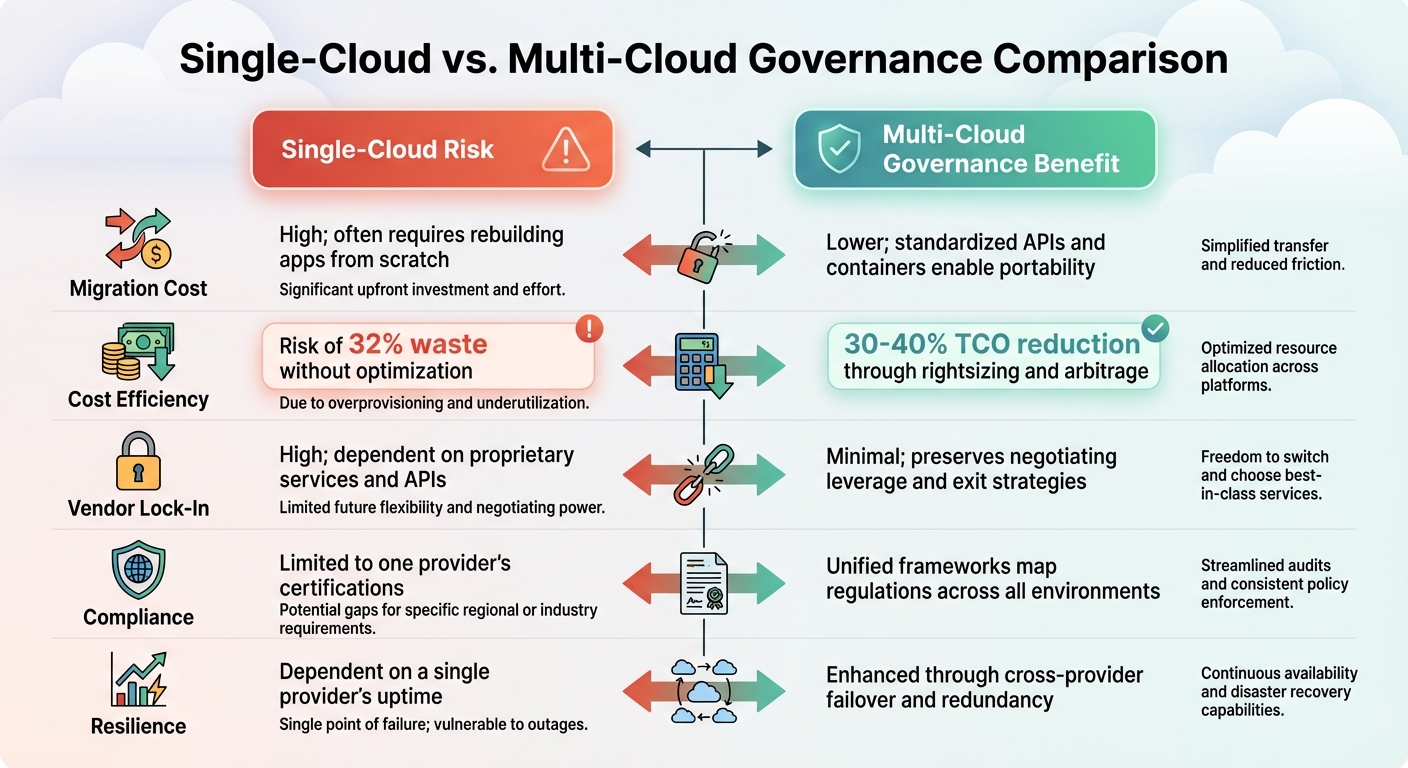
Single-Cloud vs Multi-Cloud Governance: Cost, Risk, and Flexibility Comparison
Standardization plays a key role in ensuring flexibility over the long haul. Relying on proprietary data formats and APIs often makes switching cloud providers an expensive and complicated process. By adopting standardized multi-cloud models, organizations can cut total cost of ownership (TCO) by 30–40% compared to sticking with a single-cloud setup.
Standardization Best Practices
To keep deployments consistent and provider-neutral, containerize your applications using tools like Docker and Kubernetes. Pair this with Infrastructure as Code (IaC) solutions such as Terraform or Ansible. This combination abstracts away cloud-specific differences, allowing workloads to shift between providers without the need for major rework.
Start by standardizing logging and metrics formats early. This ensures that data from different providers can be analyzed side-by-side without compatibility issues. Established frameworks like ISO/IEC 19941 and IEEE P2301/P2302 offer guidance on how to move data between systems effectively. These frameworks also help maintain a solid governance strategy as cloud providers update their offerings. Additionally, enforce a tagging strategy to better manage resource ownership and costs – automatically removing untagged resources can prevent waste and confusion.
Regular testing is just as important as standardization itself. Conduct quarterly disaster recovery simulations to validate your migration strategies and confirm that workloads remain portable. Walmart provides a great example of this in action. In its hybrid multi-cloud environment, the company uses automated failover mechanisms to maintain uptime during high-demand periods, such as Black Friday.
Table: Single-Cloud vs. Multi-Cloud Comparison
| Feature | Single-Cloud Risk | Multi-Cloud Governance Benefit |
|---|---|---|
| Migration Cost | High; often requires rebuilding apps from scratch. | Lower; standardized APIs and containers enable portability. |
| Cost Efficiency | Risk of 32% waste without optimization. | 30–40% TCO reduction through rightsizing and arbitrage. |
| Vendor Lock-In | High; dependent on proprietary services and APIs. | Minimal; preserves negotiating leverage and exit strategies. |
| Compliance | Limited to one provider’s certifications. | Unified frameworks map regulations across all environments. |
| Resilience | Dependent on a single provider’s uptime. | Enhanced through cross-provider failover and redundancy. |
Conclusion
Multi-cloud governance transforms vendor dependency into a model of flexible, strategic control. By standardizing tools like Kubernetes and Terraform, organizations ensure portability while capitalizing on the unique strengths of each cloud provider. Advanced implementations can cut total costs by 30–40%, thanks to centralized visibility and automated Policy-as-Code practices that curb resource waste and uphold security standards.
A clear example of this comes from Goldman Sachs. In October 2025, they split workloads between AWS for trading and Google Cloud for AI/ML, resulting in analytics that were 40% faster.
This level of operational control is made possible through containerized, standardized solutions. Using containerized apps, cloud-agnostic APIs, and unified logging formats, businesses can move workloads between providers without incurring costly rebuilds. For instance, BMW manages its connected vehicle systems across Azure and AWS with automated governance policies that maintain global security while giving the company leverage in vendor negotiations.
The key takeaway? Governance frameworks that enable smooth deployment rather than hindering it are the ones that succeed. Teams equipped with clear guardrails can deploy faster and with greater confidence, knowing exactly where the boundaries lie.
Looking ahead, the multi-cloud governance market is set to expand from $12.52 billion in 2024 to an impressive $147 billion by 2034. Organizations that adopt phased roadmaps, open standards, and centralized management systems will be well-positioned to scale efficiently. They’ll avoid being locked into a single vendor’s pricing or roadmap, striking the perfect balance between control and innovation – hallmarks of effective multi-cloud governance.
FAQs
How can multi-cloud governance prevent vendor lock-in?
Multi-cloud governance helps businesses avoid being locked into a single vendor’s ecosystem by providing centralized control and visibility across multiple cloud providers. This means you can standardize management, enforce policies, and automate operations seamlessly, making it easier to shift workloads or adjust to new requirements.
By adopting strategies like tagging resources, keeping an eye on performance, and leveraging open-source tools like Kubernetes or Terraform, companies can achieve greater flexibility and portability. This not only helps maintain control and keep costs in check but also reduces reliance on a single provider, allowing businesses to stay nimble in a multi-cloud setup.
What are the key steps to implement effective multi-cloud governance?
Effective multi-cloud governance boils down to a few key actions that help maintain control, security, and flexibility across various cloud platforms. Here’s how to get started:
Begin by establishing centralized visibility for all your cloud resources. This means using tools and processes that give you a clear picture of assets across providers. Pair this with a consistent tagging system to easily track ownership, usage, and environments.
Next, create and enforce clear policies to ensure consistency across platforms. Automating tasks like compliance checks and remediation through policy-as-code can save time and reduce manual work. It also ensures that governance standards are consistently followed. Make it a habit to regularly review workloads and costs, ensuring they align with your strategic objectives, improve resource efficiency, and avoid dependence on a single vendor.
Lastly, promote cross-team collaboration by integrating security and operational best practices into your processes. Use automation to apply governance policies seamlessly while keeping your operations agile. This not only minimizes risks but also strengthens resilience, ensuring your multi-cloud setup stays secure and efficient.
How can businesses maintain security and compliance when using multiple cloud providers?
To keep security tight and meet compliance requirements across various cloud platforms, businesses should adopt a centralized governance strategy. This means establishing uniform security policies, automating their enforcement, and maintaining clear visibility across all cloud environments. One effective method is tagging resources with clear ownership and purpose, which helps avoid unmanaged assets that could pose security risks.
Leveraging tools for continuous monitoring, drift detection, and automated remediation allows companies to spot and address compliance issues before they escalate. Regular audits combined with automation ensure that policies are consistently enforced. A strong security framework – incorporating identity management, encryption, and network protections tailored to each cloud provider – further safeguards sensitive data and critical infrastructure. These measures enable companies to meet regulatory standards while keeping control and flexibility in their multi-cloud operations.