Egress Is Eating Your Margins: Immediate Tactics to Reduce Outbound Transfer Spend
Egress fees – charges for moving data out of your cloud provider’s network – can quietly drain 20–40% of your cloud budget. These costs grow faster than your business, penalizing SaaS and AI companies with high data transfer needs. Cloud providers mark up these fees by as much as 8,000%, turning them into a major financial burden.
Here’s how you can reduce egress costs quickly:
- Use VPC Endpoints and PrivateLink: Avoid public internet fees by enabling private communication between AWS services.
- Deploy CloudFront CDN: Reduce origin traffic by caching content closer to users.
- Place Data Closer to Users: Align storage and compute regions to eliminate cross-region transfer fees.
For long-term savings:
- AWS Direct Connect: Use private connections to cut costs on large data transfers.
- Bare Metal Kubernetes: Avoid per-GB billing by switching to predictable, capacity-based pricing.
Start with quick fixes for immediate relief, then explore structural changes to control costs as your business scales.
Reducing cloud egress charges: 10 common pitfalls and how to avoid them [Cloud Masters #121]
sbb-itb-f9e5962
What Are Egress Fees and Why They Matter
Egress fees are the charges cloud providers impose when data exits their network – whether it’s heading to the public internet, another cloud provider, or even your on-premises data center. Think of it as a one-way toll: while bringing data into the network (called "ingress") is free, you’re charged every time data leaves. This pricing strategy isn’t accidental. Free ingress encourages data storage, while egress fees create a financial hurdle for moving data elsewhere.
These fees are calculated based on a few factors: data volume (measured per gigabyte), destination (e.g., public internet, another region, or another availability zone), and transfer path (such as through NAT Gateways or Load Balancers). Providers often use tiered pricing, where costs decrease as the amount of data transferred increases. For instance, AWS charges approximately $0.09/GB for the first 10 TB of internet egress, $0.02/GB for transfers between regions within the U.S., and $0.01/GB per direction for traffic between availability zones.
One important detail: cross-availability zone (AZ) transfers are billed in both directions. So, moving 1 GB across an AZ boundary effectively costs $0.02/GB because you’re charged for both the "out" and the "in". These fees can sneak into unexpected places, like database replication between zones, load balancer traffic, or even log shipping to monitoring systems. Next, we’ll break down where your egress dollars are actually going.
Where Your Egress Money Goes
Egress spending typically comes from four main sources:
- Public internet transfers: Every time a user downloads a file, receives an API response, or streams content from your app, you’re incurring charges. This adds up quickly for platforms with heavy media use or SaaS products serving a global audience.
- Cross-region replication: Keeping disaster recovery backups or ensuring high availability across multiple regions means any replicated object counts as outbound data from the source region.
- Cross-availability zone traffic: Engineers often refer to this as "microservices chatter." When application servers in one AZ communicate with databases in another, you’re paying for every single request.
- Multi-cloud strategies: Moving data between providers – like transferring data from AWS to Google BigQuery for analytics – results in egress fees at every step.
As your operations grow, these cost drivers can significantly increase your overall egress spending.
How Egress Costs Grow with Your Company
Egress costs don’t grow at the same pace as your business – they accelerate. One SaaS company saw a tenfold increase in users lead to a fifteenfold jump in egress expenses, climbing from $400 to $6,200 per month. Why? As the product matured, users accessed more resource-heavy features more frequently.
For AI companies, the challenge is even greater. Training models involves moving enormous datasets between storage and compute clusters, while serving inference results to users generates constant internet egress.
Consider cross-region replication: transferring 10 TB of data monthly between AWS regions – like from us-east-1 to eu-west-1 for compliance or performance – can cost over $900 per month. And here’s the kicker: over 60% of enterprises underestimate their inter-region data transfer costs, leading to unplanned budget overruns. With unmanaged inter-region traffic making up 15%–20% of total cloud waste, these fees can quickly become a major financial burden.
Quick Tactics to Cut Egress Costs Now
These tips help cut egress costs quickly without requiring a major infrastructure overhaul. Each method focuses on reducing specific types of waste, like unnecessary external traffic, duplicate origin requests, or avoidable cross-region data transfers. By addressing these common problem areas, you can achieve immediate savings.
Set Up VPC Endpoints and PrivateLink
Using VPC endpoints allows your AWS resources to communicate with services like S3 and DynamoDB without touching the public internet. This eliminates the $0.09/GB internet egress fee entirely. There are two types of endpoints to consider:
- Gateway Endpoints: These are free and work with S3 and DynamoDB. They don’t incur any hourly or data processing charges and take just minutes to set up.
- Interface Endpoints: Powered by PrivateLink, these are designed for other services (like EC2 API or Kinesis). While there’s a small hourly fee, the data transfer cost drops to about $0.01/GB for the first petabyte.
To set up a Gateway Endpoint, go to the AWS VPC console and create an endpoint for S3 or DynamoDB. Select your service, VPC, and route tables. AWS will handle the routing setup, allowing EC2 instances to access S3 privately instead of routing through a NAT Gateway.
For Interface Endpoints, select the service, VPC, and subnets. Enable the Private DNS name and configure your security group to allow HTTPS traffic (port 443). While not free, Interface Endpoints significantly reduce outbound data costs compared to public internet traffic.
This method is a quick way to cut unnecessary outbound data costs and sets the stage for further optimization.
Deploy CloudFront CDN to Reduce Origin Traffic
When you use CloudFront CDN, data transferred from AWS origins like S3, EC2, or Application Load Balancers to CloudFront is free. This eliminates standard data transfer-out fees. CloudFront serves content from over 400 global edge locations, ensuring most user requests never hit your origin servers.
To maximize savings:
- Set longer Time-to-Live (TTL) values for static assets.
- Enable file compression (e.g., Gzip or Brotli) to lower origin traffic.
- Use CloudFront’s request-collapsing feature, which ensures only one origin request is made, even if multiple users request the same file simultaneously.
The CloudFront free tier offers 1 TB of data transfer out and 10 million requests per month. For localized audiences, using Price Class 100 (North America and Europe) can reduce delivery costs by up to 50% compared to serving from all global regions. High-traffic applications may benefit from enabling Origin Shield, a centralized caching layer that reduces load on your origin by fetching data through fewer requests.
This approach quickly minimizes outbound data while improving content delivery efficiency.
Place Data Closer to Your Users
Aligning S3 bucket locations with your compute regions avoids cross-region transfer fees. Similarly, keeping load balancers and backend servers in the same Availability Zone (AZ) prevents inter-AZ charges. Auditing your setup for mismatches and relocating resources to the same region or AZ can save money right away.
Here are additional tips:
- Use private IPs for intra-AZ traffic to avoid charges that public or elastic IPs might trigger, even within the same region.
- Choose lower-cost regions when latency requirements allow. For instance, US and Canadian regions tend to be less expensive, while regions like India, Singapore, and parts of South America often have higher fees.
- Use tools like VPC Flow Logs and CloudWatch to identify high cross-region or cross-AZ traffic. Adjusting your architecture based on these insights can lead to immediate savings.
"Optimizing egress isn’t about reducing consumption – it’s about controlling movement." – Transcloud
Long-Term Strategies for Bigger Egress Savings
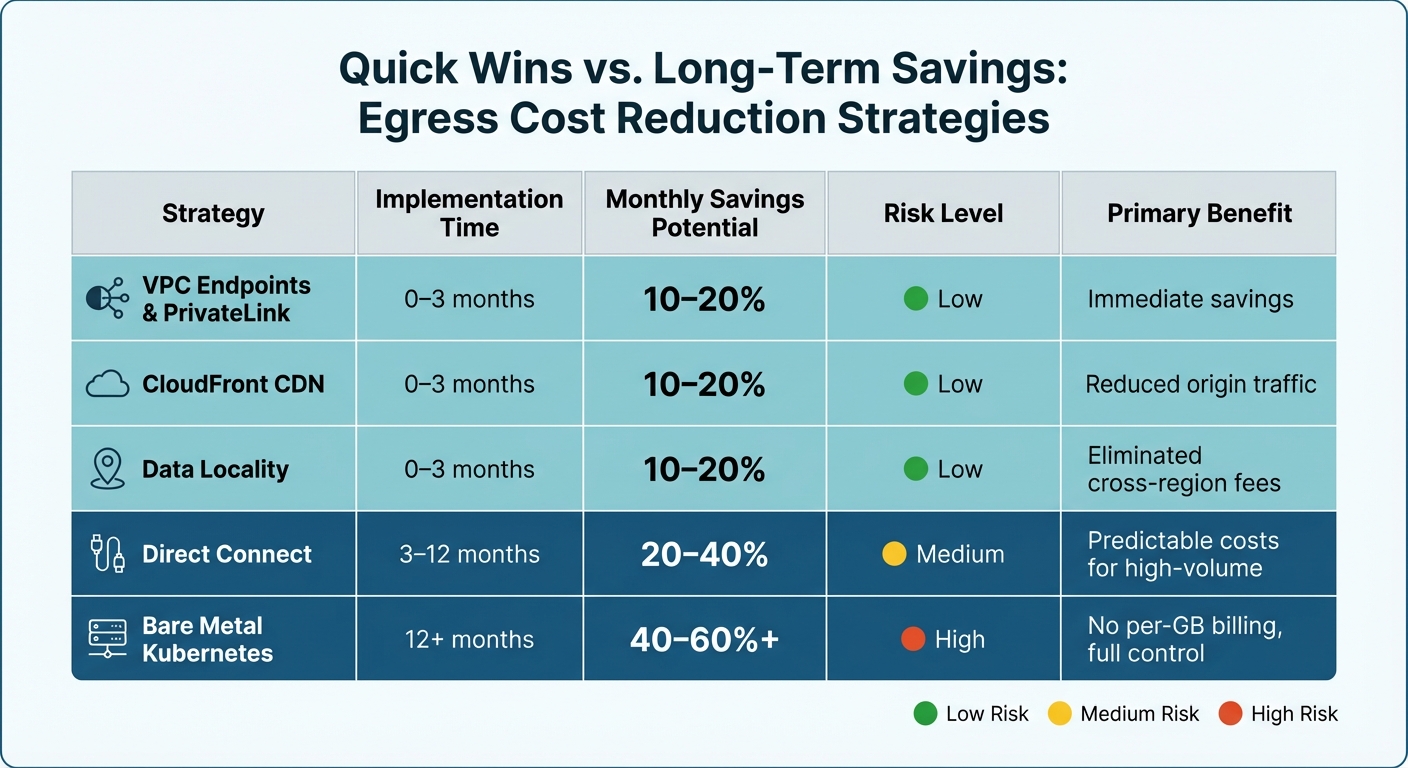
Quick Wins vs Long-Term Cloud Egress Cost Reduction Strategies
Short-term fixes can help you cut costs quickly, but if you’re aiming for substantial savings over time, structural changes are the way to go. These strategies can transform how you manage egress costs entirely.
Use Direct Connect for Private Connectivity
AWS Direct Connect offers a dedicated connection between your data center and AWS, bypassing the public internet. This private link can lower Data Transfer Out rates to $0.02 per GB in US-EAST-1 – far cheaper than the typical internet egress fees of around $0.09 per GB. Plus, it provides a more stable and predictable network by avoiding the latency and routing issues of public internet connections.
"Direct Connect is a networking service that provides an alternative to using the internet to connect to AWS… In many circumstances, private network connections can reduce costs, increase bandwidth, and provide a more consistent network experience than internet-based connections." – AWS Documentation
The cost for a 10 Gbps dedicated connection is about $2.25 per hour, making it a great option for teams transferring large amounts of data frequently. If a dedicated link feels like overkill, AWS Partners offer hosted connections that can reduce port hour costs. Additionally, the Direct Connect Gateway allows you to connect up to 20 VPCs across different AWS Regions using a single private virtual interface – perfect for multi-region setups.
If you’re not ready for a full Direct Connect setup, VPC Endpoints are a more accessible option. They eliminate NAT Gateway and public internet charges for services like S3 and DynamoDB, helping you save without major infrastructure changes.
Move to Bare Metal Kubernetes with TechVZero
Managed cloud providers often charge between $0.08 and $0.20 per GB for outbound data. In contrast, bare metal providers use a capacity-based pricing model – you pay for a dedicated 1 Gbps or 10 Gbps link, regardless of how much data you move [3,32]. This eliminates per-GB billing and ensures steady, predictable costs.
TechVZero’s bare metal Kubernetes infrastructure provides the reliability of managed cloud services at 40-60% lower costs. By removing the hypervisor layer, applications gain direct access to hardware, which boosts performance for resource-intensive workloads. For comparison, managed services like EKS charge about $73 per month just for the control plane, while bare metal lets you run your own control plane without incurring that extra cost.
In December 2025, Ark Protocol transitioned away from the cloud for their consistent backend workloads, such as APIs, workers, and databases like Postgres. Over six months, they saved $250,000 while maintaining the same level of reliability. This switch reduced network fees by as much as 850% compared to managed cloud pricing.
"Cloud pricing is designed to reward bursty workloads and punish steady ones that run all day. When you run boring compute at high utilization for months, you are paying for convenience every minute." – Ark Protocol
TechVZero simplifies the process for teams of 10-50 people. Their pricing model takes 25% of your savings for a year, and if they don’t meet their promised cost reductions, you owe them nothing. They also ensure compliance with SOC2, HIPAA, and ISO standards, aligning with your timeline instead of dragging out the process.
Quick Wins vs. Long-Term Savings: Comparison Table
Here’s a breakdown of how quick wins stack up against long-term strategies, focusing on implementation time, savings potential, and risk.
| Strategy | Implementation Time | Monthly Savings Potential | Risk Level | Primary Benefit |
|---|---|---|---|---|
| VPC Endpoints & PrivateLink | 0–3 months | 10–20% | Low | Immediate savings |
| CloudFront CDN | 0–3 months | 10–20% | Low | Reduced origin traffic |
| Data Locality | 0–3 months | 10–20% | Low | Eliminated cross-region fees |
| Direct Connect | 3–12 months | 20–40% | Medium | Predictable costs for high-volume |
| Bare Metal Kubernetes | 12+ months | 40–60%+ | High | No per-GB billing, full control |
Quick wins are easy to implement and deliver immediate savings with minimal disruption. On the other hand, long-term strategies require more effort and expertise but can fundamentally change your cost structure. Many teams start with quick wins and then explore options like Direct Connect or bare metal Kubernetes as they analyze traffic patterns and develop their internal capabilities.
Conclusion: Take Back Your Margins from Egress Costs
By following the strategies outlined earlier, you can start reclaiming your profit margins by managing egress costs more effectively. The approach lies in balancing immediate actions with more sustainable, structural changes.
Quick solutions like VPC Endpoints, CloudFront CDN, and data consolidation can provide immediate cost relief. Meanwhile, options such as Direct Connect and bare metal Kubernetes set the stage for long-term savings. These measures not only reduce unnecessary egress traffic but also create predictable cost structures that grow alongside your business needs.
For instance, TechVZero’s bare metal Kubernetes infrastructure eliminates per-GB billing entirely, offering 40–60% lower costs while still delivering the reliability of managed cloud services.
"Egress has emerged as one of the most underestimated forces in cloud economics." – Fluence
With both short-term fixes and long-term strategies in hand, the path forward is clear. Start by implementing a quick win to see immediate results, while laying the groundwork for sustainable cost management. Acting now ensures you’ll enjoy stable and predictable margins, even as others struggle with rising costs.
FAQs
How can I quickly lower egress costs for outbound data transfers?
To cut down on egress costs effectively, try these strategies:
- Utilize content delivery networks (CDNs): CDNs store frequently accessed data at edge locations, reducing the need for repeated outbound traffic from your cloud setup.
- Add caching layers: By setting up caching layers for your applications and databases, you can decrease redundant data transfers and improve efficiency.
- Switch to dedicated network connections: Opt for options like Direct Connect instead of VPNs to streamline data transfers and lower expenses.
These approaches not only trim costs but also help resolve inefficiencies in how data is transferred.
How do egress fees affect SaaS and AI companies differently?
Egress fees impact SaaS and AI companies in different ways, largely because of how they manage and transfer data.
For SaaS companies, data transfers are usually more predictable and involve smaller amounts. These businesses often focus on user-facing applications, where strategies like optimizing storage locations or using content delivery networks (CDNs) can help control costs effectively.
In contrast, AI companies grapple with much larger and more unpredictable data transfers. Tasks like moving massive training datasets, updating models, or sharing inference results often require transferring significant volumes of data across regions or cloud providers. This leads to higher egress fees that can be harder to manage. To address these challenges, AI companies might rely on techniques like data compression, private connectivity options, or creating workflows tailored to specific regions.
While both industries deal with egress fees, the sheer scale and frequency of data movement make this issue a bigger challenge for AI companies.
What are the advantages of using AWS Direct Connect for transferring data?
AWS Direct Connect brings a range of benefits for data transfer, starting with consistent, low-latency performance. Unlike the unpredictable nature of public internet connections, it delivers a steady and reliable network experience. This makes it ideal for applications where performance consistency is critical.
On top of that, it can help lower network costs by reducing outbound data transfer fees. If you’re managing large-scale data transfers, the increased bandwidth it offers ensures these operations run smoothly and efficiently.
Another standout feature is the private and secure connection it provides to AWS services. This setup not only boosts reliability but also minimizes the risk of interruptions. For businesses that prioritize predictable performance and cost-effective cloud management, AWS Direct Connect is an excellent choice.