AI-Powered Incident Resolution: Role of Temporal Context

AI-driven systems are changing how incidents are resolved by focusing on temporal context – understanding not just what went wrong, but when and how events are connected over time. This approach improves accuracy, reduces noise, and speeds up issue resolution. Here’s the key takeaway:
- Temporal context uses time-sensitive data (timestamps, historical patterns, event dependencies) to link related incidents and identify root causes faster.
- Systems with temporal awareness reduce alert clutter by up to 90% and cut Mean Time to Resolution (MTTR) by 50-70%.
- Organizations save millions by resolving issues more efficiently – IT downtime can cost up to $9,000 per minute.
- Tools like Temporal and systems like AidAI leverage historical data, dependencies, and workflows to improve diagnosis accuracy and reliability.
Incident Resolution with Digitate’s ignio AI Agent
Research Findings on Temporal Context in AI Systems
Recent research highlights how incorporating temporal context into AI systems can significantly enhance their performance, especially in reducing Mean Time to Resolution (MTTR). By analyzing how events unfold over time, these systems provide deeper insights and improved outcomes.
Performance Gains from Temporal Awareness
A study by Microsoft examined 353 incidents and found that integrating historical incident data and upstream dependencies boosted root cause recommendation accuracy. Similarly, the AidAI system demonstrated its effectiveness across 1,300 incidents, achieving a Micro F1 score of 0.854 and a Macro F1 score of 0.816 – outperforming traditional models that only reached 48.1% accuracy. Another breakthrough, the TimeCAP framework, which employs dual AI agents for textual summaries and predictions, improved F1 scores by 28.75% compared to existing methods. Additionally, leveraging service functionalities and component descriptions in GPT-4 prompts enhanced Service Level Objective (SLO) classification accuracy and F1 scores by 4% in monitor categorization tasks.
Future Trends in Temporal-Aware AI Systems
These advancements point to a shift in the industry toward embracing temporal-aware AI systems. Gartner forecasts that by 2029, 80% of routine incidents will be resolved using these advanced AI capabilities. Leigh McMullen, Distinguished VP Analyst at Gartner, emphasized:
"Between now and 2029, forward-looking CIOs will need to incorporate [disruptive technologies] into their strategies".
Modern observability platforms are also evolving, with Temporal Knowledge Graphs now mapping service and infrastructure relationships in real-time. These platforms incorporate human inputs – like comments, resolution notes, and investigation steps – to transform informal, team-specific knowledge into structured system intelligence. Riley Peronto, Sr. Product Marketing Manager at Chronosphere, explained:
"The issue isn’t the AI itself. It’s the context these tools work with… If your AI tool can only reason about standardized data, it’s operating with an incomplete picture".
Another key trend is the move away from feeding AI raw telemetry data. Instead, pre-analyzed insights are being used to trace error propagation through service graphs, pinpointing the original failure sources. Given that developers currently spend about 57% of their time managing incidents, these temporal-aware systems not only enhance reliability but also lead to substantial cost savings for organizations managing complex infrastructures.
Techniques for Managing Temporal Context in AI Workflows
Handling temporal context effectively in AI workflows relies on two main strategies: ensuring the system maintains a durable state despite potential failures and embedding temporal context directly into AI models. These approaches help preserve critical information during incident resolution, even when unexpected disruptions occur.
Temporal State Management in Workflow Systems
Workflow orchestration platforms tackle state persistence by logging each step of a process as an event. Traditional systems often require a full restart if an AI system crashes mid-task, leading to wasted time and higher API costs. Systems like Temporal, however, use an "Event History" – an append-only log of workflow steps – to recover seamlessly from the exact point of failure, avoiding unnecessary re-execution of tasks.
This design separates the core business logic (Workflows) from external interactions like API requests or calls to large language models (LLMs). During recovery, the system retrieves previously recorded results instead of redoing expensive operations. For instance, in 2024, Replit transitioned its coding agent control plane to Temporal for large-scale orchestration, eliminating edge cases that previously caused poor user experiences. Connor Brewster, Lead Engineer at Replit, highlighted the benefits:
"Temporal gives us a lot more confidence to build the product and know that it’s not going to have lots of edge cases that lead to bad user experiences".
Similarly, in 2025, Gorgias, an e-commerce platform serving over 15,000 brands, adopted Temporal-based AI agents to improve reliability and user satisfaction. Both Replit and Gorgias leveraged durable workflows to minimize downtime and enhance their systems’ resilience. Features like built-in retry policies and timeouts further ensure workflows don’t stall during outages.
By maintaining a durable state, these systems provide a strong foundation for integrating temporal context into AI models.
Engineering Temporal Context in AI Models
While durable workflows ensure continuity, AI models need additional engineering to interpret and apply temporal information. Since LLMs are inherently stateless, developers must persistently store conversation histories, tool outputs, and timestamps within workflow variables to provide the necessary context. One effective method is temporal grounding – embedding explicit dates into AI prompts (e.g., "Assume today is January 5, 2026"). Research shows that without such grounding, 80% of AI responses lack accuracy, whereas grounded prompts improve forecast precision by 10%.
For complex, multi-step tasks, developers chain outputs from one tool directly into the next model input to maintain a seamless flow of context. In cases where processes generate extensive event histories, the "Continue-As-New" feature helps by truncating older data while preserving essential details. Additionally, Signals allow real-time updates or human corrections to be injected into workflows without interrupting their execution. This capability enables smooth human-in-the-loop collaboration for critical decision-making scenarios.
sbb-itb-f9e5962
Real-World Applications and Use Cases
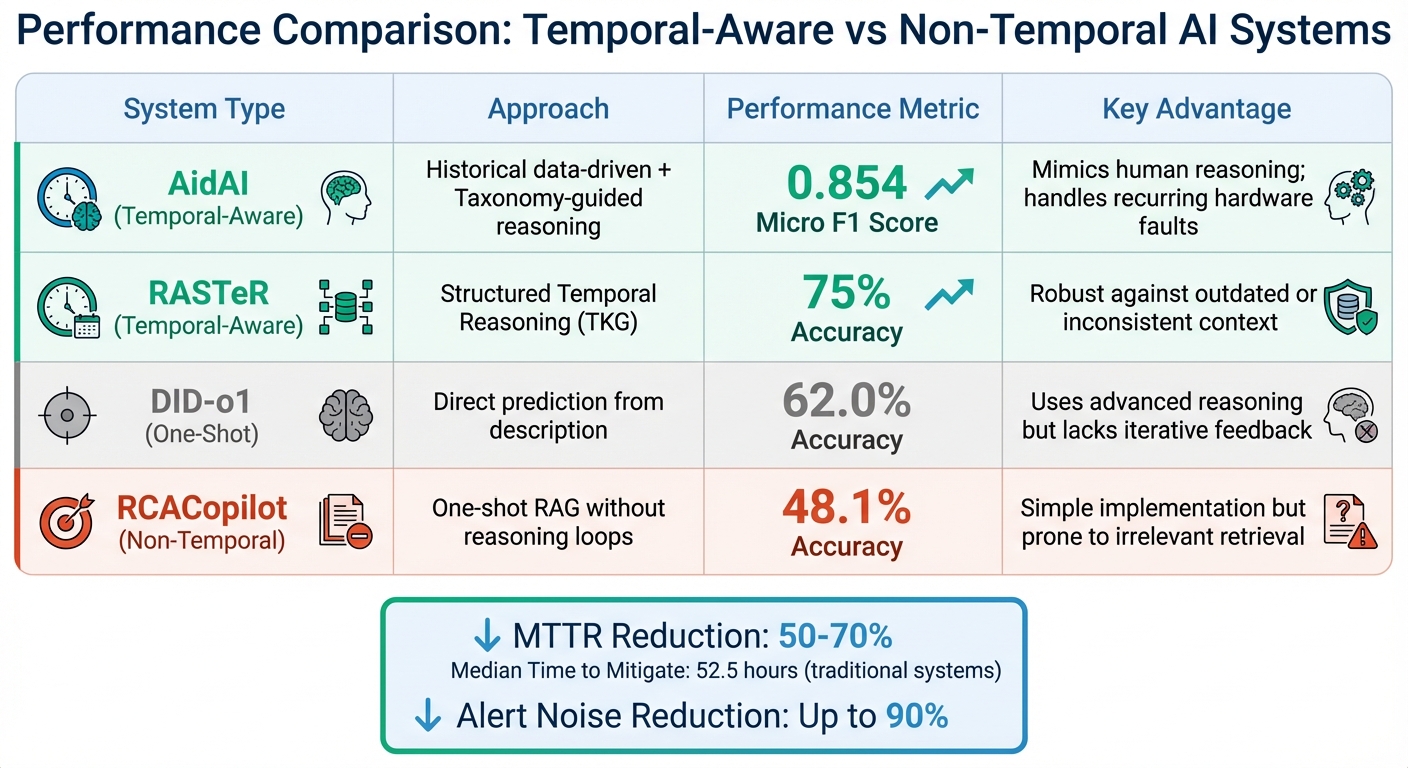
Temporal-Aware vs Non-Temporal AI Systems Performance Comparison
Use Cases in Customer Support and E-commerce
Microsoft researchers studied 353 high-impact IC3 incidents over a year and found a way to improve how dependency failures are diagnosed. By using an X-lifecycle learning pipeline, which combined AI prompts with upstream service dependencies and historical incident summaries, they achieved far better accuracy in identifying root causes than standard models. This is a big deal, especially in e-commerce, where downtime during peak seasons can cost as much as $100 million per hour. Clearly, adding temporal context to these systems can significantly reduce downtime and improve precision when resolving incidents.
In November 2025, Chronosphere showcased its "Guided Troubleshooting" feature in a real-world checkout failure scenario. The AI detected that payment processor errors began three minutes before the checkout service failed by analyzing temporal patterns in metrics and traces. This insight saved engineers 20 minutes of manual troubleshooting. Riley Peronto, Senior Product Marketing Manager at Chronosphere, explained the challenge:
"Troubleshooting is still manual and dependent on tribal knowledge. Each incident can feel like starting from scratch".
On another front, Microsoft Research Asia examined 1,300 incident records from three GPU clusters and introduced AidAI, a system that builds internal knowledge bases from past on-call experiences. In one example, a PCIe degradation failure in a 1,024-GPU task caused a 40-minute delay, wasting over $1,700 in compute time. AidAI tackled such issues using a taxonomy-guided, multi-step diagnosis process, achieving a Micro F1 score of 0.854. This temporal-aware approach proved especially effective for resolving complex hardware and software mismatches.
Performance Comparison: Temporal-Aware vs. Non-Temporal AI
The examples above highlight how temporal awareness can deliver measurable results. Here’s a look at how these systems compare in performance:
Temporal-aware systems have shown they can reduce Mean Time to Repair (MTTR) by 50–70% and cut alert noise by up to 90%. Considering that the median Time to Mitigate (TTM) for production incidents in large cloud environments is roughly 52.5 hours, AI-driven solutions offer much-needed speed and efficiency.
| System Type | Approach | Performance Metric | Key Advantage |
|---|---|---|---|
| AidAI (Temporal-Aware) | Historical data-driven + Taxonomy-guided reasoning | 0.854 Micro F1 Score | Mimics human reasoning; handles recurring hardware faults |
| RASTeR (Temporal-Aware) | Structured Temporal Reasoning (TKG) | 75% Accuracy | Robust against outdated or inconsistent context |
| DID-o1 (One-Shot) | Direct prediction from description | 62.0% Accuracy | Uses advanced reasoning but lacks iterative feedback |
| RCACopilot (Non-Temporal) | One-shot RAG without reasoning loops | 48.1% Accuracy | Simple implementation but prone to irrelevant retrieval |
These comparisons make it clear: temporal-aware AI systems are transforming how incidents are diagnosed and resolved, offering faster and more reliable solutions than their non-temporal counterparts.
TechVZero‘s Approach to Temporal Optimization

Bare Metal Kubernetes Migrations for Low-Latency Processing
TechVZero takes a unique approach by running Kubernetes on bare metal servers to achieve ultra-low latency. This configuration not only enhances the ability to process temporal patterns but also slashes infrastructure overhead by an impressive 40–60%. By using workflows-as-code tools like Temporal, the platform maintains state effectively and ensures automatic retries, which keeps operations smooth even during disruptions. Another standout feature is its continuous mapping of service-to-infrastructure relationships, which provides a detailed understanding of the environment. On top of that, TechVZero’s advanced analytics and temporal correlation techniques shrink data volumes by an average of 84%, cutting down both storage and processing costs.
This well-structured infrastructure delivers tangible operational savings while boosting system resilience.
Proven Results: Cost Savings and System Reliability
TechVZero’s methods have delivered real-world results, like saving a client $333,000 in just one month while successfully countering a DDoS attack. This highlights how temporal optimization can improve both cost efficiency and security. The platform uses unsupervised learning algorithms to cluster alerts that occur together, reducing ticket volume by treating related issues as a single incident. It also identifies recurring patterns, such as alerts that typically surface during the first week of every month, and applies grouping policies that refine themselves over time. By processing operational data in real time, the system detects anomalies early, preventing them from escalating. Additionally, enhancing AI prompts with detailed insights into service functionality and components has been shown to significantly improve classification accuracy.
Currently operating across more than 99,000 nodes, TechVZero offers a pricing model where it earns 25% of the savings achieved over a year, with no charges if performance targets are not met.
Conclusion
In today’s fast-paced tech landscape, understanding the element of time has become crucial for AI-driven incident resolution. Systems that can track how failures unfold over time, maintain temporal knowledge graphs to map service relationships, and learn from past patterns are proving to analyze problems far faster than traditional manual methods ever could.
The real-world impact of temporal-aware AI is already evident. For instance, enriching AI prompts with data spanning the entire lifecycle of a system has boosted classification accuracy by 4%. Additionally, multi-agent systems that incorporate temporal awareness have reached an impressive 92% acceptance rate among human reviewers for diagnostic reasoning. These advancements reduce reliance on senior-level expertise, making complex troubleshooting more accessible to teams across the board.
As highlighted earlier, these techniques are at the core of TechVZero’s success in cutting costs and improving reliability. By optimizing processes with temporal insights, the platform has achieved tangible results, like slashing infrastructure costs by 40–60% while enabling faster incident resolution. With a reach spanning over 99,000 nodes and performance-based pricing, TechVZero showcases how temporal optimization can deliver real, measurable benefits.
FAQs
How does understanding temporal context enhance AI-driven incident resolution?
AI systems equipped with temporal context can take into account specific time periods or recent events to analyze and address issues effectively. By incorporating the current system state and historical patterns into their reasoning, these systems can offer solutions that are more precise, relevant, and timely.
This capability enhances the efficiency of pinpointing root causes and applying fixes, which helps minimize downtime and keeps systems running smoothly. Integrating temporal context enables AI to make decisions that are both informed by context and immediately actionable.
How do temporal-aware AI systems improve incident resolution compared to traditional models?
Temporal-aware AI systems use historical and lifecycle data to deliver more precise root-cause analysis, detect incidents more effectively, and drastically cut down the mean time to resolution (MTTR). By analyzing patterns and trends over time, these systems excel at identifying and resolving issues compared to traditional single-stage or rule-based models.
This method boosts the dependability of incident resolution while helping organizations reduce downtime and improve overall system performance. It’s a game-changer for modern IT operations.
How do AI systems that use temporal context help organizations save money?
AI systems that use temporal context are game-changers for organizations looking to cut costs. By analyzing real-time data, these systems can quickly detect, route, and address incidents, reducing downtime and limiting the need for manual intervention. This proactive approach helps prevent disruptions that could otherwise be expensive.
With time-sensitive insights driving automated incident resolution, companies can allocate resources more effectively, boost system reliability, and lower operational costs. The outcome? A smarter, more efficient way to manage IT operations while avoiding the hefty price tag of unexpected outages.