How to Align DevOps Teams with Business Goals

DevOps success isn’t just about uptime or deployment speed – it’s about driving business results. Many teams excel technically but fail to connect their efforts to revenue, customer satisfaction, or growth. This disconnect is why 70% of digital transformation initiatives fall short. To bridge the gap, you need to align technical work with business priorities.
Here’s what works:
- Understand business goals: Prioritize objectives like customer retention, cost reduction, or market expansion.
- Translate goals into technical tasks: For example, reduce Mean Time to Recovery (MTTR) to minimize revenue loss from downtime.
- Track meaningful metrics: Combine DevOps metrics (like deployment frequency) with business KPIs (like customer satisfaction).
- Collaborate across teams: Integrated teams from DevOps and business units ensure alignment.
- Use feedback loops: Regular reviews and dashboards connect technical work to business outcomes.
Successful DevOps Starts With Organizational Alignment
Translate Business Goals into Technical Objectives
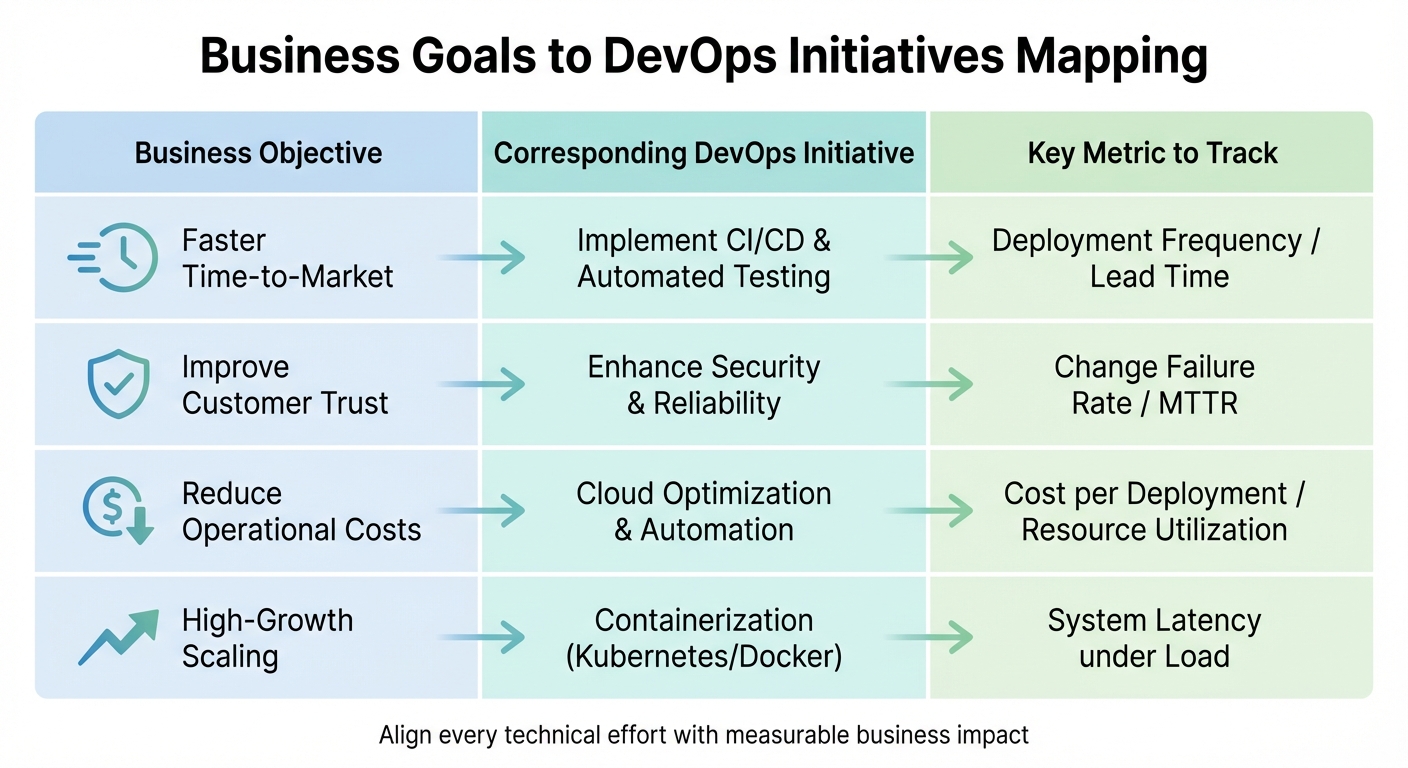
DevOps Business Alignment: Mapping Business Objectives to Technical Initiatives
Identify Key Business Objectives
To align technical efforts with business priorities, it’s crucial to first understand what leadership values most. This often involves participating in structured planning sessions where senior leaders outline their objectives. For instance, Amazon’s S-Team model illustrates this well – executives establish overarching goals, and teams develop detailed operating plans (OP1/OP2) to ensure technical work supports these priorities.
The next step is to define specifics. Is the focus on improving customer retention, expanding into new markets, or cutting costs? Each goal demands tailored technical strategies. Take JDM Sliding Doors as an example. They realized their traditional "system uptime" metric was irrelevant when sync errors were blocking technicians from accessing vital systems. Gal Cohen, their Business Development Leader, reframed the issue by prioritizing "time-to-resolution" for sync errors, treating them as revenue blockers rather than minor inconveniences. The team responded by creating self-healing scripts to resolve failures automatically, preventing disruptions before they could escalate.
Regular business reviews are another essential tool. They help verify whether the chosen metrics are still aligned with business goals. For example, Amazon tracks "orders per minute" as a key performance indicator (KPI) for its e-commerce operations. If this metric drops during their Weekly Business Reviews (WBRs), it’s a clear signal that technical problems are negatively impacting customer experience and revenue. This prompts immediate action to address the issues.
Once business priorities are clearly outlined, the next step is translating them into actionable technical initiatives.
Map Business Goals to DevOps Initiatives
Now that the business objectives are defined, the challenge lies in breaking them down into measurable DevOps tasks. This involves identifying technical metrics that directly support the business goals. For example, if customer retention is a priority, a DevOps initiative might focus on reducing Mean Time to Recovery (MTTR) from days to hours – because downtime directly impacts revenue.
A case in point is VPSServer, where CEO Tal Holtzer introduced a KPI connecting deployment frequency to client satisfaction. By ensuring faster updates led to better uptime, the company achieved a 25% boost in deployment efficiency and improved client retention. The key takeaway: deployments only matter if they drive meaningful business outcomes.
Here’s a quick reference table linking common business objectives with their corresponding DevOps initiatives and metrics:
| Business Objective | Corresponding DevOps Initiative | Key Metric to Track |
|---|---|---|
| Faster Time-to-Market | Implement CI/CD & Automated Testing | Deployment Frequency / Lead Time |
| Improve Customer Trust | Enhance Security & Reliability | Change Failure Rate / MTTR |
| Reduce Operational Costs | Cloud Optimization & Automation | Cost per Deployment / Resource Utilization |
| High-Growth Scaling | Containerization (Kubernetes/Docker) | System Latency under Load |
This approach ensures that every technical effort ties back to a measurable business impact, creating a seamless connection between strategy and execution.
Define Metrics and KPIs That Connect DevOps to Business Outcomes
Differentiate Between Technical Metrics and Business KPIs
Technical metrics and business KPIs serve distinct roles, but they need to complement each other. Technical metrics, such as DORA metrics – deployment frequency, lead time, change failure rate, and time to restore service – help measure the efficiency of your DevOps pipeline. They focus on how software is delivered. On the other hand, business KPIs target broader organizational goals like revenue growth, customer satisfaction, and market share, addressing the why behind these technical efforts.
While aligning technical tasks to business goals is crucial, it’s equally important to ensure that metrics reflect both user impact and revenue outcomes. Technical excellence alone doesn’t guarantee business success. As Gartner points out:
"DevOps Research and Assessment metrics, which are the de facto industry standard for DevOps benchmarking, provide insufficient visibility into the key organization-enabling factors required for success".
For example, a DevOps team might excel in DORA metrics, deploying updates multiple times a day. However, if these deployments don’t enhance customer experience or revenue, the business value remains unclear.
Amazon’s e-commerce operations illustrate this balance well. The team tracks "orders per minute" as a core business KPI. If this metric dips below expectations, engineers immediately examine technical metrics – such as latency or error rates – to identify potential system issues impacting customer experience and revenue.
By understanding the distinction between technical metrics and business KPIs, you can build a metrics framework that directly ties DevOps efforts to meaningful business outcomes.
Set Up a Metrics Framework
To connect DevOps activities with business impact, start by establishing a clear metrics framework. Identify key measurements that both technical and non-technical teams can agree on. Tools like the DORA quick check can provide actionable insights without requiring perfect data. Focus on aligning organizational priorities rather than obsessing over measurement precision.
Your framework should strike a balance between speed and stability. High-performing teams deploy on demand, with lead times under an hour, change failure rates between 0–15%, and service restoration times also under an hour. However, prioritizing stability metrics – like change failure rate and time to restore service – before emphasizing speed can help avoid unintended consequences.
A real-world example comes from May 2025, when Crypto Recovers launched a new crypto wallet recovery tool. Robbert Bink utilized shared dashboards to track deployment frequency and lead time alongside customer churn and feature adoption. This approach allowed teams to connect rapid deployments directly to improved user feedback and a successful product launch. Presenting such metrics in accessible formats can help leadership make informed, data-driven decisions without requiring deep technical expertise. This bridges the gap between daily engineering work and broader business strategies.
Incorporating Weekly Business Reviews (WBRs) into your process helps maintain alignment between technical metrics and evolving business priorities. WBRs also provide an opportunity to catch potential issues early, ensuring your framework remains relevant and effective.
Build Cross-Functional Teams for Better Collaboration
Form Integrated Teams
To break down silos and improve collaboration, create teams that bring together experts from development, operations, and business units like marketing, sales, and customer support. This ensures technical decisions align with actual business needs. A great example is when VPSServer CEO Tal Holtzer restructured his teams in May 2025. He introduced a KPI linking deployment frequency directly to client satisfaction, which clarified roles and fostered stronger cooperation between DevOps and business teams. The result? A 25% boost in deployment efficiency and improved client retention rates.
"We were able to encourage our DevOps and business teams to interact more effectively by evaluating the rate at which we issue updates and making certain that these updates lead to improvements in both uptime and performance."
– Tal Holtzer, CEO, VPSServer
Another key step is establishing a working agreement – a social contract that outlines how team members will collaborate, communicate, and share responsibilities. Revisiting this agreement every 6–12 months helps accommodate changes in team dynamics and business goals. To stay ahead of potential issues, consider running pre-mortem sessions at the start of projects and holding bi-weekly or monthly retrospectives to review progress and identify areas for improvement.
Once integrated teams are in place, the next step is ensuring shared visibility to align technical efforts with business outcomes.
Create Shared Visibility
Shared dashboards are a powerful way to translate technical metrics into clear business insights. When Crypto Recovers introduced a new crypto wallet recovery tool in May 2025, Robbert Bink implemented dashboards that tracked deployment frequency and lead time alongside business metrics like customer churn and feature adoption. This allowed both technical and business teams to see how faster deployments drove higher feature adoption rates.
The best dashboards combine DevOps KPIs – like deployment frequency and change failure rate – with business metrics such as customer satisfaction and revenue impact. Tools such as Prometheus, Grafana, Datadog, and Splunk provide real-time feedback on system health, while platforms like Jira and Slack keep everyone on the same page regarding progress and challenges.
This approach worked wonders at JDM Sliding Doors. By highlighting sync errors as revenue blockers, the team was able to implement automated self-healing scripts that resolved issues before technicians even noticed them.
"Once we shifted DevOps accountability to ‘time-to-resolution,’ they started treating these issues as revenue blockers rather than just minor glitches."
– Gal Cohen, Business Development Leader, JDM Sliding Doors
sbb-itb-f9e5962
Implement Continuous Feedback Loops
Gather Feedback From Stakeholders
Getting input from the right people at the right time is crucial to keeping DevOps efforts aligned with business goals. Tools like A/B testing, automated monitoring, and customer polls provide immediate feedback on new features and help refine sprint retrospectives.
Stakeholders aren’t just limited to leadership. It’s just as important to include input from marketing, sales, customer support, and even internal departments that act as your "customers" in larger organizations. Incorporating key business KPIs into this feedback process ensures technical reviews are triggered when necessary. These metrics can then be reviewed during Weekly Business Reviews.
To make feedback collection more structured, consider using "Stop, Start, Keep" retrospectives at the end of each sprint. This approach encourages stakeholders to highlight practices to stop, new ideas to try, and processes that are working well. Tools like shared dashboards, Scrum boards, or Kanban boards can make work more transparent. Following up on feedback is equally important – it ensures that the input leads to real, measurable improvements.
Once the feedback is in hand, the next step is to quickly integrate these insights into the development cycle.
Adapt Strategies Based on Feedback
Feedback is only useful if it drives action. Instead of letting feedback sit idle in spreadsheets, integrate it directly into your workflow – as backlog items or OpsItems. For instance, JDM Sliding Doors shifted their DevOps focus from "system uptime" to "time-to-resolution" after discovering that sync errors were preventing technicians from accessing appointment details. This insight led to the creation of automated self-healing scripts, which resolved issues before they could affect revenue.
Recurring system alerts should be addressed immediately to avoid accumulating technical debt and to keep the focus on improvements that matter to the business. Weekly Business Reviews offer an opportunity to connect technical metrics like latency or error rates with business outcomes such as revenue or customer satisfaction. Additionally, processes like Amazon’s two-stage annual planning (OP1 and OP2) allow teams to adjust strategies based on changing customer needs and insights gathered throughout the year.
Secure Leadership Support and Resources
Present DevOps as a Business Investment
When pitching DevOps to executives, focus on its business impact rather than just the technical aspects. Leaders care about outcomes like faster cash flow and stronger market positioning. For example, instead of saying, "We need to reduce cycle time", you could frame it as: "Our cycle time is 4 weeks, while competitors release in 5 days, which has caused a 9% drop in sales".
Start with small, high-visibility pilot projects that produce measurable results. These proof-of-concept initiatives not only demonstrate value but also establish credibility for larger investments down the line.
Concrete metrics are your best ally when justifying further funding. High-performing DevOps teams, for instance, are twice as likely to exceed targets for profitability, market share, and productivity. They deploy code 46 times more frequently and achieve lead times that are 440 times faster than low-performing teams. To quantify potential savings, use this formula: (technical staff size) x (average salary) x (benefits multiplier) x (percentage of time spent on unnecessary rework). Collaborate with your finance department early to ensure these calculations are accurate. Interestingly, while 90% of organizations say the main goal of a business case is to secure funding, 40% admit to inflating benefits to get approval.
Once you’ve proven the value of DevOps, the next step is embedding these initiatives into your organization’s regular planning cycles.
Ensure Resource Allocation
Securing a budget is just the beginning. To keep DevOps initiatives thriving, they need to be supported through consistent resource planning. Incorporate DevOps into your organization’s regular planning cycles instead of treating it as a one-off IT project. For instance, Amazon uses a two-iteration operating plan process: OP1 gathers bottom-up proposals aligned with business goals, and OP2 refines these plans based on shifting priorities before finalizing.
Shift from funding isolated projects to a more integrated, value-driven budgeting approach. Instead of forcing IT components to compete for limited funds, align budgets with business value streams and customer outcomes. A capability assessment can help pinpoint gaps and justify investments in both personnel and tools. This is especially important since only 36% of enterprise organizations have fully established cross-functional DevOps teams. If you’re still working on this, you’re not alone.
Focus on initiatives that deliver quick wins to build momentum. Early successes, especially those with immediate revenue impact, can demonstrate value quickly and pave the way for sustained resource allocation.
Monitor Progress and Continuously Improve
Track KPIs and Metrics
When tracking performance, don’t limit yourself to just DORA metrics. While Deployment Frequency, Lead Time for Changes, Change Failure Rate, and Time to Restore Service are crucial, they only tell part of the story. As Gartner points out:
"DevOps Research and Assessment metrics… provide insufficient visibility into the key organization-enabling factors required for success".
To get a fuller picture, combine business KPIs with technical metrics. For example, if you notice a sudden drop in orders per minute, it could signal a technical issue. Tools with predefined thresholds and alerts for such deviations can help you catch problems early.
If you’re just starting with DevOps, focus on stability metrics like Change Failure Rate and Mean Time to Restore Service before shifting attention to speed. To achieve an "Elite" DORA ranking, aim for a failure rate between 0–15% and ensure service restoration happens in under an hour. These benchmarks not only improve operations but also provide a clear foundation for executive-level reporting.
Report Results to Leadership
When presenting to leadership, focus on how DevOps directly impacts business goals. Use dashboards that simplify technical data into actionable insights. Instead of overwhelming executives with deployment frequency graphs, show how faster deployments drive revenue growth or improve customer satisfaction.
Regular review meetings, like Weekly Business Reviews (WBRs), can help connect technical performance with business outcomes. For instance, reducing Mean Time to Restore Service from four hours to just 30 minutes doesn’t just boost uptime – it also supports better customer experiences and operational efficiency.
Integrate DevOps improvements into your company’s annual planning. Amazon’s approach is a great example: their OP1 planning cycle gathers bottom-up proposals aligned with business objectives, while OP2 refines these plans to address shifting priorities. This ensures DevOps remains a key part of the organization’s strategic roadmap.
Iterate and Improve
Continuous improvement is essential. Use regular review cycles to refine processes through a "sense, seize, and transform" approach: identify opportunities or risks, respond with new capabilities, and adjust your structure as needed. Recurring alerts, for instance, often signal deeper inefficiencies that should be resolved before rolling out new features.
Conduct annual capability assessments to evaluate your progress and adjust priorities based on changing business needs. One company linked deployment frequency to client satisfaction and saw a 25% boost in deployment efficiency. These iterative improvements ensure your DevOps strategy keeps pace with evolving goals.
Collaboration is key. Gather feedback from all stakeholders and aim for consensus on what to improve – even if the data isn’t perfect. As Werner Vogels, Amazon’s CTO, wisely says:
"Everything fails, all the time".
The aim isn’t perfection – it’s about continuous progress that aligns with your business objectives.
Conclusion
When DevOps teams align with business goals, they shift from being just a technical support function to becoming a key driver of value – impacting revenue, customer satisfaction, and market expansion. This connection between technical execution and business priorities ensures every deployment and improvement contributes to meaningful outcomes for both leadership and customers.
Without proper alignment, many digital transformation efforts fall short. However, organizations that achieve this alignment often see measurable benefits. These successes not only validate technical efforts but also propel broader business achievements.
To maintain this alignment, focus on linking technical upgrades to business KPIs, fostering collaboration through cross-functional teams, and creating continuous feedback loops to adapt as priorities evolve. As AWS emphasizes:
"DevOps adoption should not be an isolated project within the organization. It should be aligned to broader business goals… so that the resources and effort put into adopting DevOps are also directly improving business outcomes".
This approach elevates DevOps from a purely technical role to a central business function.
Organizations that excel treat DevOps as an ongoing strategic initiative, not a one-off project. They concentrate on impactful changes that reduce customer pain points, engage leadership by presenting DevOps as a strategic asset, and consistently adapt to evolving market needs. When technical teams understand the purpose behind their work and business leaders recognize the tangible returns on DevOps investments, this alignment becomes the bedrock of long-term competitive success.
FAQs
How can DevOps teams align their work with business goals?
DevOps teams can connect their technical efforts to business objectives by promoting open communication and teamwork with stakeholders. Sharing updates on progress, roadmaps, and goals on a regular basis helps everyone stay aligned and understand how the team’s work supports the overall mission.
Taking a close look at current DevOps practices can uncover areas that need improvement and highlight tasks that align with strategic priorities. Incorporating business-oriented metrics – such as revenue growth, customer satisfaction, or operational efficiency – into workflows ensures the team remains focused on delivering results that matter.
When teams prioritize transparency, reassess their focus, and measure success with meaningful metrics, they create a direct link between their work and real business outcomes.
What are the key metrics for aligning DevOps with business goals?
To ensure DevOps aligns with business goals, it’s important to track metrics that bridge technical performance with broader objectives. Start by focusing on crucial indicators like deployment frequency, lead time for changes, and mean time to recovery (MTTR) – these reveal how quickly and reliably software is delivered. Metrics such as uptime, cost per deployment, and vulnerability detection rate also provide insight into operational efficiency and security.
But it’s not just about the technical side. Think about how factors like system performance and error rates affect customer satisfaction, revenue, and market growth. Regularly reviewing these metrics with stakeholders helps ensure that DevOps initiatives deliver measurable value to the business. The real challenge lies in prioritizing metrics that are both actionable and representative of operational health and strategic impact.
How can cross-functional teams bridge the gap between DevOps and business goals?
Cross-functional teams play a key role in connecting DevOps practices with business objectives. By improving communication and building a shared understanding of priorities, these teams ensure that everyone is on the same page. Regular discussions about progress, roadmaps, and goals with stakeholders help boost transparency and make it clear how individual contributions drive the company forward.
When development, operations, and business units work together in a unified workflow, collaboration becomes smoother, and teams can act on feedback more efficiently. Using shared metrics, defining clear roles, and maintaining open lines of communication helps create an environment where DevOps efforts directly support broader business goals. The result? Fewer delays, higher productivity, and stronger alignment with what the organization aims to achieve.