Contract Clauses That Prevent Surprise Marketplace Charges

Cloud costs can spiral out of control if contracts lack key protections. Many businesses face hidden fees, unpredictable bills, and unexpected price hikes from cloud providers. For example, 42% of companies struggle to predict cloud expenses, and 28% report surprise charges. These issues often stem from vague terms, auto-renewals, and unilateral pricing changes by vendors.
To manage costs effectively, focus on these contract clauses:
- Usage Limits & Alerts: Define clear limits (e.g., storage, bandwidth) and require alerts at 80% and 90% of thresholds to avoid surprises.
- Fee Caps: Limit annual price increases to 3–5% or tie them to inflation.
- Third-Party Fees Transparency: Demand upfront disclosure of all costs, including hidden ones like training or migration fees.
- Billing Accuracy: Require detailed invoices and allow a 90-day dispute window without penalties.
- Flexibility in Usage Commitments: Negotiate rights to reduce unused capacity by 15–25% annually.
After signing, consistent monitoring is crucial. Set automated alerts, conduct quarterly reviews, and optimize resources to prevent waste. Without these safeguards, unexpected costs can hurt your bottom line.
What is Cloud Contract Management & Why You Shouldn’t Overlook It
sbb-itb-f9e5962
Contract Clauses That Prevent Surprise Charges
Avoiding unexpected cloud costs often comes down to a few key contract provisions. These clauses can help you take control by setting clear limits on charges and ensuring proper notifications.
Usage Limits and Overage Notifications
To keep your cloud expenses predictable, it’s essential to define usage limits with measurable terms. Instead of vague language, specify exact metrics like bandwidth in GBps or MBps, storage in GB or TB, and precise numbers for API calls. For example, aim for terms such as "50 named users, 1,000,000 API calls per month, and 500 GB storage" rather than leaving it open to interpretation.
Set automated alerts at 80% and 90% of your usage limits. This gives you time to adjust before overage fees kick in. Make sure any overage charges are capped at your standard contract rate, not inflated premium rates. Negotiate a 15-day grace period after hitting your limit before those fees apply. Also, require the provider to notify you when you’re nearing 90% of your limit, with overage charges billed only after the grace period at the agreed-upon rate.
For added control, include a clause that requires your pre-approval for any charges exceeding the agreed limits.
Transparency in Third-Party Fees
Surprise fees often stem from hidden costs, so demand upfront disclosure of all charges. This includes implementation, training, support, integration, and migration fees. Prohibit auto-enrollment in trials that automatically convert to paid services without your explicit consent.
To avoid billing surprises, include an audit clause that allows you to review charges and request itemized invoices. Define key terms like "user" (e.g., named vs. concurrent), "storage" (e.g., 1 TB vs. vague "reasonable use"), and how API calls are measured. Prevent vendors from making unilateral changes by enforcing a feature freeze with a 90-day notice and an option to terminate if needed.
Fee Adjustment and Renewal Caps
Keep annual price increases in check by capping them at 3–5% or tying them to the Consumer Price Index (CPI), whichever is lower. Watch out for vendors who multiply the cap by the number of years in the renewal term, turning a 3% cap into a 9% increase over three years.
"Renewal price protection language, once a safeguard for customers, is being rewritten by SaaS vendors in subtle but costly ways." – Adam Mansfield, UpperEdge
Replace vague terms like "Vendor may increase pricing at any time with 30 days’ notice" with clauses that cap increases and require at least 60–90 days’ written notice before any renewal or price changes take effect.
For usage-based models, negotiate the flexibility to reduce your committed consumption by 15–25% annually if you’re not using your full allocation. This helps prevent overpaying for unused capacity, which is a common issue in enterprise agreements.
Billing Accuracy and Dispute Resolution
Demand detailed, itemized invoices in US dollars that clearly break down charges by service and usage period. This level of transparency makes it easier to spot errors or unexpected fees.
Include a 90-day window to dispute charges without risking service suspension. During disputes, you should have the right to withhold the contested amount in good faith without losing access or incurring late fees.
Although late payment fees typically hover around 1.5% per month (or 18% annually), negotiate a 10–15 day grace period to avoid penalties for minor delays while resolving disputes.
These clauses create a solid foundation for managing cloud costs effectively. By addressing these details upfront, you’ll be better equipped to handle any surprises and maintain control over your budget long after the contract is signed.
How to Negotiate Cloud Provider Agreements
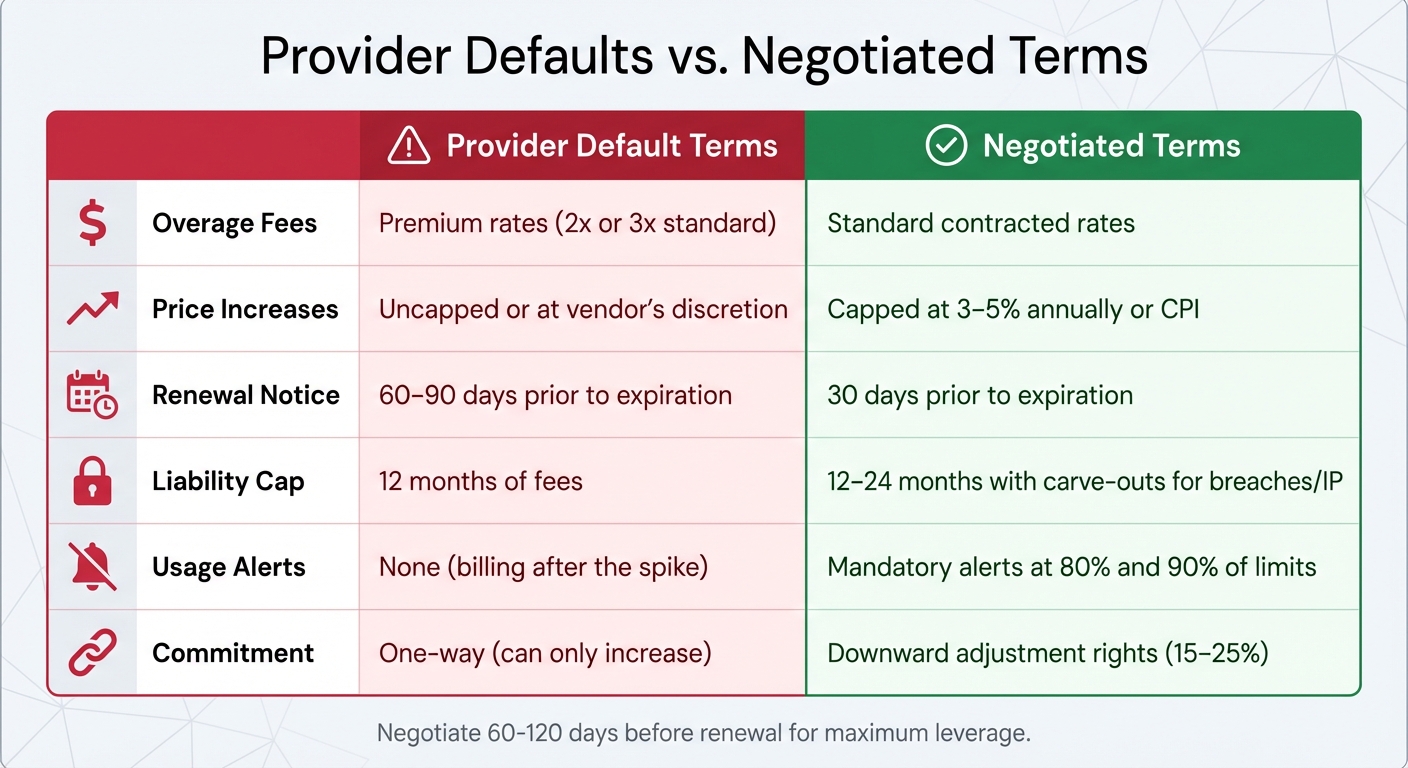
Cloud Contract Terms: Provider Defaults vs Negotiated Terms Comparison
Securing favorable terms in cloud provider agreements goes beyond simply accepting the standard terms presented. Providers often default to terms that prioritize their revenue, leaving your budget at risk. To negotiate effectively, you need to identify which clauses to challenge and how to advocate for better protections.
Reviewing and Adjusting Order Forms
Start by scrutinizing every detail in the order form and Statement of Work (SOW). Ensure all promised features, user seats, and support levels are clearly documented to avoid unexpected charges later on. Be specific about user numbers and storage limits to prevent disputes.
It’s also a good idea to simulate usage based on growth projections. Test scenarios at 100%, 150%, and 200% of your expected consumption to uncover potential overage fees that might escalate as you scale. This exercise can reveal hidden costs that aren’t immediately obvious. Push for tiered pricing that adjusts gradually instead of rigid subscriptions with steep penalties for exceeding limits.
If you’re working with major cloud marketplaces like AWS, Azure, or GCP, explore "Private Offers." These deals can provide customized pricing and payment options that differ from public list prices. For example, negotiate Flexible Payment Schedules (FPS) to break annual payments into monthly installments. This approach can help you manage cash flow while still leveraging marketplace benefits.
Capping Liability and Reducing Risk
Once billing details are locked in, shift your focus to minimizing financial risk.
Standard contracts often cap vendor liability at 12 months of fees paid, while leaving your obligations uncapped. This creates a one-sided risk scenario. Negotiate for mutual liability caps and push for higher limits – ideally 3–5 times the annual fees – for issues like data breaches, intellectual property violations, or confidentiality breaches.
"The clause effectively converts your ‘fixed-price’ commitment into a floating-price obligation where the vendor controls the float." – Fredrik Filipsson, Redress Compliance
Be wary of clauses that allow vendors to change pricing with just 30 days’ notice. Instead, negotiate fixed pricing for the contract’s duration, limiting changes to on-demand overages. Additionally, request a mid-term downward adjustment right, which lets you reduce your committed consumption by 15–25% annually if you’re not using your full allocation. This helps avoid "stranded spend", a common issue where enterprises overcommit by 40–60% compared to actual usage.
Finally, include a termination for convenience clause with a 30–90 day notice period and pro-rata refunds for prepaid fees. This ensures flexibility if your business needs change unexpectedly.
Provider Defaults vs. Negotiated Terms
Understanding the default terms offered by providers can help you pinpoint areas to negotiate. Here’s a comparison of typical defaults versus negotiated terms:
| Term | Provider Default | Negotiated Term |
|---|---|---|
| Overage Fees | Premium rates (2x or 3x standard) | Standard contracted rates |
| Price Increases | Uncapped or at vendor’s discretion | Capped at 3–5% annually or CPI |
| Renewal Notice | 60–90 days prior to expiration | 30 days prior to expiration |
| Liability Cap | 12 months of fees | 12–24 months with carve-outs for breaches/IP |
| Usage Alerts | None (billing after the spike) | Mandatory alerts at 80% and 90% of limits |
| Commitment | One-way (can only increase) | Downward adjustment rights (15–25%) |
To maximize your leverage, start negotiations 60–120 days before renewal deadlines. Vendors are often more flexible near the end of their fiscal quarter or year, as sales teams work to meet quotas. If a vendor insists their master agreement is non-negotiable, propose a side letter or amendment to address specific concerns without overhauling the entire contract.
Metrics-Driven Cost Management After Signing
Signing a contract with favorable terms is just the beginning. Without consistent monitoring, even the best-negotiated agreements won’t shield you from unexpected costs. In fact, a 2023 survey revealed that 94% of respondents faced avoidable cloud expenses. This highlights how many companies overlook potential savings by failing to track their spending closely.
Once your contract terms are in place, ongoing metrics-driven monitoring ensures those safeguards translate into actual cost savings.
Setting Up Cost Alerts in DevOps
Automated tiered cost alerts are essential for identifying spending spikes as they happen. Set thresholds at key levels: 50% (early warning), 80% (trend investigation), 100% (budget reached), and 120% (critical overspend requiring immediate action).
"Cost monitoring alerts are a safety net that every cloud deployment needs. By defining them in Terraform, you ensure that budget guardrails are always in place and updated as your infrastructure evolves." – Nawaz Dhandala
Pair these fixed alerts with machine-learning-based anomaly detection to catch both expected and unexpected spending patterns. Keep in mind that anomaly detection often has a 1–2 day delay since it requires complete daily data for accurate analysis.
Route alerts directly to team collaboration tools like Slack or Microsoft Teams, ensuring the DevOps team can respond quickly. Additionally, set up service-specific budgets for high-cost items like EC2, BigQuery, or SaaS integrations to pinpoint which service is driving a spike. For services like BigQuery, consider implementing per-project or per-user budgets for even greater control. Beyond notifications, automate enforcement with tools like Cloud Functions (GCP) or Lambda (AWS) to scale down resources or halt billing when critical thresholds are hit.
Quarterly Spend Reviews and Benchmarking
Regular quarterly reviews are critical for identifying and eliminating idle resources. Look for instances operating below 5% peak CPU utilization or unattached volumes. Cleaning up unused resources can save 10–20% within 30 days, while further optimizations can add another 20–35% in savings.
Evaluate your commitment coverage to ensure Savings Plans and Reserved Instances are being used effectively. Aim to cover 60–70% of steady-state usage with Compute Savings Plans. Upgrading storage from EBS gp2 to gp3 volumes offers immediate savings, with costs dropping from $0.10/GiB-month to $0.08/GiB-month. Similarly, AWS Graviton processors can deliver up to 40% better price-performance compared to x86-based instances.
"Review and adjust budgets quarterly. As your workload grows, budgets need to grow too." – Nawaz Dhandala
Don’t forget to audit all geographic regions, not just your primary ones. Overlooked resources like unattached Elastic IPs (costing $0.005/hr each) or idle NAT Gateways (around $32/month plus data fees) can lead to unnecessary charges. Also, track unit economics – such as cost per customer, transaction, or request – to ensure spending aligns with business value.
Checklist for Avoiding Common Pitfalls
During your quarterly reviews, use this checklist to ensure your cost controls remain effective:
- Tagging Enforcement: Block untagged CI/CD deployments.
- Log Retention Policies: Set CloudWatch Logs retention to a specific duration (e.g., 7 days) to avoid excessive storage costs.
- VPC Endpoints: Replace NAT Gateways with Gateway Endpoints (free for S3/DynamoDB) to cut data transfer fees.
- Snapshot Management: Take snapshots before deleting idle resources; retention costs are usually lower than the expense of recreating lost data.
- Forecast Accuracy: Monitor the gap between predicted and actual spend. Advanced teams aim for a variance of ±10–12%, while others might target ±15%.
Automating daily monitoring can catch spending anomalies far faster than waiting for monthly billing cycles.
Conclusion
Surprise marketplace charges often arise from contract terms that favor providers. Auto-renewal clauses are the leading cause of unexpected charges in SaaS agreements. If these contracts aren’t carefully negotiated, you could face uncapped price hikes, unclear usage terms, and billing disputes that drain resources and eat into your margins.
The agreements you sign today will shape your costs for years to come. To avoid financial pitfalls, make sure annual price increases are capped or tied to inflation. Negotiate for usage alerts at 80% or 90% of your limits to prevent unexpected overage charges. Push for termination rights that include pro-rata refunds to eliminate waste and control costs. These terms aren’t just nice-to-haves – they’re essential for maintaining predictable spending and avoiding chaos.
"SaaS contract negotiation isn’t just a procurement exercise. It’s a strategic control point that directly impacts spend efficiency, vendor lock-in, security posture, and operational flexibility." – Deepanjali, CloudEagle.ai
But strong contract terms are only half the battle. Continuous, data-driven cost monitoring after signing is just as critical. With 42% of businesses unable to predict their monthly cloud expenses accurately, regular oversight is a must. Use tiered alerts, conduct quarterly audits, and rely on data insights to prepare for renewal talks 60–120 days before the contract ends.
FAQs
Which contract terms cause the most surprise marketplace charges?
The biggest culprits behind unexpected marketplace charges are automatic price escalation clauses and hidden renewal clauses. Automatic price escalation clauses bump up costs without any prior negotiation, while hidden renewal clauses can quietly hike renewal prices over time. These terms often slip under the radar, leaving businesses surprised by unplanned expenses tied to marketplace services.
What should a usage-limit and overage-alert clause include?
To keep costs under control and avoid surprises, a usage-limit and overage-alert clause should clearly outline the metrics being monitored – such as usage, storage, or service levels. It should also set precise thresholds for these limits and mandate timely notifications when usage approaches or surpasses those thresholds. This way, you can stay informed and manage expenses more effectively.
How can I negotiate renewal price caps and avoid auto-renewal traps?
To steer clear of unexpected charges, ask for limits on price hikes (such as 3–5%) and aim to secure fixed pricing throughout the contract period. Push back on auto-renewal clauses by requesting shorter renewal periods (like 30 days) and ensuring the contract includes clear terms that prevent automatic renewals without explicit consent. Stay on top of renewal dates by setting reminders, and try to negotiate close to the vendor’s fiscal year-end for better leverage.