Short‑Term vs Long‑Term Commitments: When to Say Yes

Managing cloud costs boils down to balancing flexibility and savings.
Cloud providers offer two main options: 1-year (short-term) and 3-year (long-term) commitments. Here’s the quick breakdown:
- Short-Term Commitments: Ideal for unpredictable or evolving workloads. Discounts range from 20–40%, offering flexibility for changes like migrations or adopting new tech. Best for usage swings over 20–25%.
- Long-Term Commitments: Best for stable, predictable workloads. Discounts reach 40–72%, but lock you in for 3 years. Suitable for core infrastructure with less than 10–15% fluctuation.
Key Metrics to Consider:
- Savings: Short-term saves less but offers flexibility. Long-term saves more but increases financial risk if usage drops.
- Risk: A 20% usage drop on $100,000/month could cost $168,000 in 1 year or $504,000 over 3 years.
- Usage Stability: Short-term tolerates high volatility; long-term works for steady demand.
Pro Tip: Many companies use a blended strategy – combining short- and long-term commitments to balance savings and flexibility.
Quick Comparison:
| Metric | 1-Year Commitment | 3-Year Commitment |
|---|---|---|
| Discount Rate | 20–40% | 40–72% |
| Flexibility | High | Low |
| Risk Exposure | Lower (12 months) | Higher (36 months) |
| Breakeven Utilization | ~80% | ~60% |
| Best For | Volatile workloads | Stable workloads |
Bottom Line: Choose short-term for flexibility or long-term for deeper savings – just ensure your usage aligns with the commitment type.
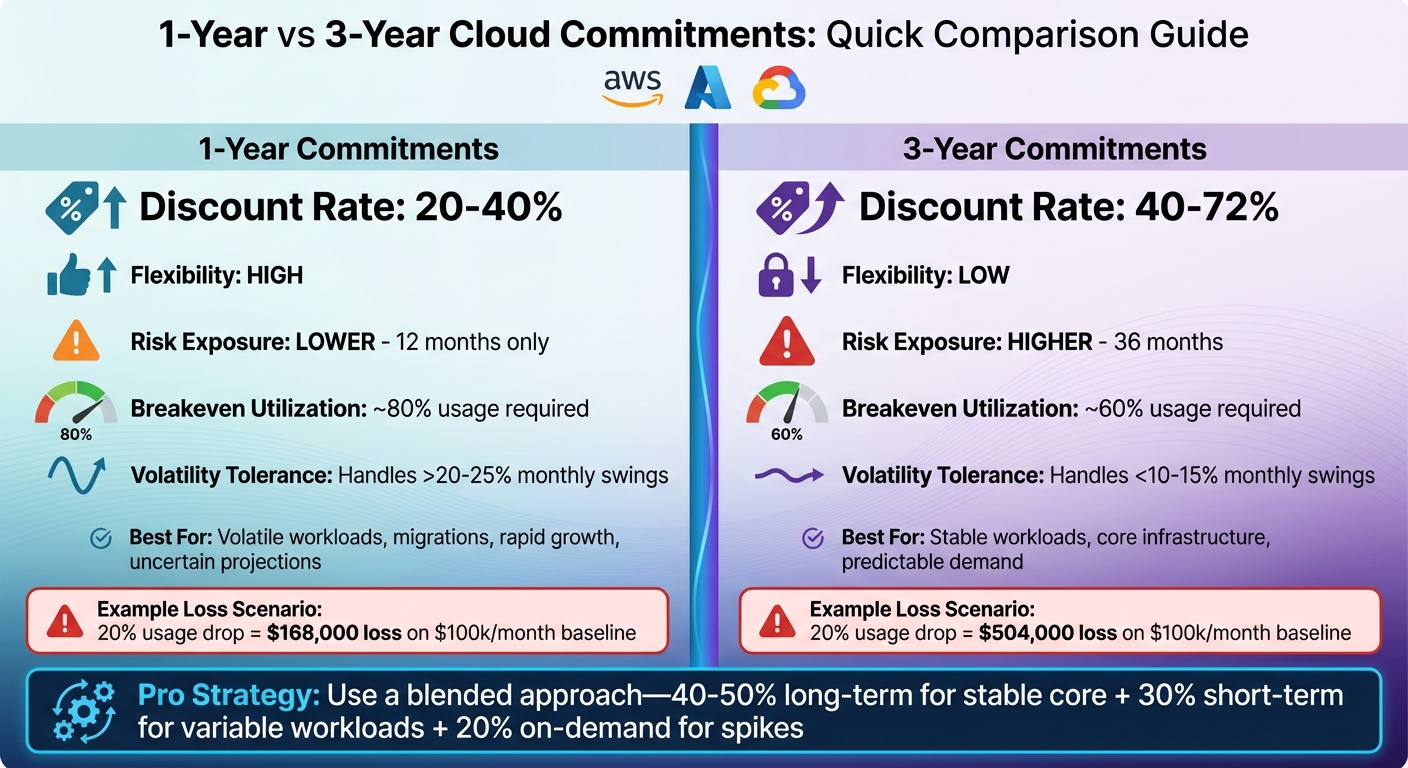
1-Year vs 3-Year Cloud Commitment Comparison: Discounts, Risk, and Best Use Cases
Side-by-Side Comparison: Short-Term vs Long-Term Commitments
What to Compare: Key Metrics
Now that we’ve outlined the basics of short-term and long-term commitments, let’s dig into the numbers that can help guide your decision. Five core metrics play a crucial role in determining which option best fits your infrastructure needs.
- Discount Rates: Short-term (1-year) commitments typically offer savings of 20–40% compared to on-demand pricing, while long-term (3-year) commitments can push those savings to 40–72%.
- Flexibility: Shorter commitments are better suited to changes like adopting new processors (e.g., Intel to Graviton) or transitioning to serverless architectures. Longer commitments, however, assume stable infrastructure for the entire term.
- Risk Exposure: The financial risk of underutilization compounds over time. A 1-year commitment limits exposure to 12 months, while a 3-year plan extends that risk to 36 months.
- Breakeven Utilization: For a 1-year deal with a 20% discount, you need to maintain at least 80% usage to break even. In contrast, a 3-year deal with a 40% discount only requires 60% usage.
- Workload Volatility Tolerance: Short-term plans can handle monthly usage swings of over 25%, while long-term plans are better suited for workloads with predictable patterns and less than 10–15% volatility.
Comparison Table
Here’s a quick breakdown of how these metrics stack up between 1-year and 3-year commitments:
| Metric | 1‑Year Commitment | 3‑Year Commitment |
|---|---|---|
| Discount Rate | 20–40% savings | 40–72% savings |
| Flexibility | High; supports annual changes | Low; assumes stable architecture |
| Risk Exposure | Lower; limited to 12 months | Higher; extends over 36 months |
| Breakeven Utilization | ~80% usage required | ~60% usage required |
| Ideal Workload | Best for volatile, growing, or shifting workloads | Best for stable, predictable workloads |
| Volatility Tolerance | Handles >20–25% monthly swings | Handles <10–15% monthly swings |
Key Takeaways
These metrics highlight the trade-offs between short-term flexibility and long-term savings. For example, while 3-year commitments offer nearly double the discount of 1-year plans, they carry significantly higher financial risk if usage drops. A 20% usage drop could result in a $168,000 loss over one year, but that loss balloons to $504,000 over three years.
This is why many organizations initially choose 1-year terms, allowing them to monitor and stabilize usage patterns before committing to a longer-term plan. These considerations set the stage for the next steps in planning your commitments, which are covered in the following sections.
sbb-itb-f9e5962
When to Choose Short-Term Commitments
Best Scenarios for Short-Term Commitments
Short-term commitments are ideal during periods of infrastructure change. If you’re planning a migration, refactor, or major architecture overhaul in the next 12–18 months – such as moving from Intel to Graviton processors or adopting serverless technologies – a 1-year term provides flexibility to adjust without financial repercussions. Similarly, companies experiencing monthly usage swings of 20–25% or more can benefit from the adaptability short-term commitments offer.
Startups and rapidly scaling SaaS companies often face uncertain growth projections. When it’s hard to predict infrastructure needs three years ahead, the risk of overcommitting with long-term agreements becomes too high. Opting for shorter terms allows these businesses to course-correct within 12 months instead of being locked in for 36.
For those seeking high coverage – covering 70–90% or more of their environment – 1-year terms help minimize the risk of overcommitting. This is especially relevant for AI companies relying on fast-changing technologies like managed data platforms, new database engines, or serverless solutions that may not have even existed a year ago.
Metrics for Evaluating Short-Term Options
When considering short-term commitments, focus on two key metrics: Effective Savings Rate (ESR) and Commitment Lock-In Risk. A good 1-year commitment should offer an ESR of at least 20% while keeping lock-in risk below 10% of your total spend. This balance ensures you save meaningfully while maintaining the flexibility that makes short-term options appealing.
The break-even utilization for a 1-year commitment typically hovers around 80%, assuming a 20% discount. Most 1-year All-Upfront Reserved Instances reach their break-even point between the 7th and 9th month. If your usage patterns consistently meet or exceed that 80% threshold, a short-term commitment can deliver strong returns without exposing you to the risks of a multi-year agreement.
How to Plan Short-Term Commitments Effectively
To maximize the benefits of short-term commitments, consider an incremental purchasing strategy. Instead of making one large annual purchase, buy smaller commitment amounts biweekly or monthly. This approach aligns your commitments with evolving usage patterns and creates staggered expiration dates, reducing the risk of being stuck with outdated capacity.
Start with a "waterline" heatmap analysis by mapping resource usage across hours and days. The lowest, consistent resource level – your "always-on waterline" – is the safest zone for commitments. For usage that fluctuates above this baseline, stick with short-term options or on-demand pricing to handle spikes and experimentation.
Many organizations adopt a layered strategy, allocating about 30% of their spend to short-term commitments for workloads that are variable or unpredictable. Before committing, calculate your "regret curve" by modeling the cost of underutilization: Baseline Spend × Coverage × % of unused commitment. This helps you visualize the financial impact of unused capacity, ensuring you size your commitments wisely.
When to Choose Long-Term Commitments
Best Scenarios for Long-Term Commitments
Long-term commitments are a smart choice when your infrastructure has reached a point of stability. If no major architectural changes are planned in the next 12–18 months, locking in a 3-year term can be a financially sound decision. The key is focusing on workloads that represent structural demand – resources that are consistently required and unlikely to shrink or shift, as opposed to elastic or experimental ones.
Examples of such workloads include production databases, core backend services, and primary application servers. These typically run 24/7 with minimal variation, making them perfect candidates for long-term agreements. If your monthly usage fluctuates by less than 10–15%, it’s a good indicator that your baseline is stable enough to justify a multi-year commitment. Moreover, if your infrastructure has standardized around a limited set of instance families and your roadmap shows no major changes ahead, the risk of overcommitting is greatly reduced. This stability allows you to benefit from discounts of up to 72% on AWS Standard Reserved Instances or up to 46% on Google Cloud‘s 3-year Flexible CUDs.
Metrics for Evaluating Long-Term Options
When considering a 3-year plan, the numbers work in your favor even with moderate utilization. For instance, a 3-year plan offering a 40% discount remains profitable at just 60% utilization. Compare this to a 1-year plan with a 20% discount, which requires an 80% utilization rate to break even. This lower threshold provides a cushion for minor usage drops.
However, the downside is the "regret cost." If your usage drops by 20% on a $100,000 baseline, the waste adds up to $168,000 over a 1-year term but skyrockets to $504,000 over a 3-year term. That’s why it’s crucial to analyze volatility before committing. Review your monthly compute usage over the past year – if fluctuations consistently stay below 15%, you’re likely in a safe position for a long-term agreement.
"3-year plans can offer nearly twice the savings, but only if your usage stays stable." – Usage.ai
AWS 3-year Savings Plans can double the incremental discount compared to 1-year plans, but they should only be applied to the irreducible core of your infrastructure – those resources that are absolutely essential and unlikely to change. With these metrics in mind, many organizations adopt a blended strategy to balance savings and flexibility.
Blended Approach: Combining Short and Long-Term Commitments
A blended strategy allows you to maximize savings while maintaining the flexibility to adapt to changing workloads. This layered approach involves applying 3-year commitments to the most stable portion of your infrastructure – typically around 40–50% of your total spend – while using 1-year terms or Savings Plans for the rest. This "50/50 split strategy" ensures you capture deep discounts on your stable core while keeping room for growth and experimentation.
Instead of making a single large purchase annually, consider spreading your commitments across smaller, monthly increments. For example, commit to 25% of your target baseline every quarter rather than locking in 100% upfront. This staggered approach creates regular decision points, giving you the flexibility to adjust as your needs evolve. It also reduces the risk of being stuck with outdated capacity if your architecture changes.
"The goal isn’t to get the highest discount. It’s to commit in a way that preserves optionality." – Udi Limor, FinOps Engineer, 2bcloud
To get the most out of your commitments, standardize around a small number of instance families and use size flexibility features to avoid hardware lock-in. A common allocation strategy is to dedicate 30% of spend to short-term commitments for variable workloads, 50% to long-term commitments for the stable core, and leave 20% on-demand for spikes and experimentation. This three-tier structure provides a balance of deep savings and the agility needed to scale in dynamic environments like SaaS or AI-driven businesses.
How to Decide: Metrics and Tools for Commitment Planning
Analyzing Workload Volatility
To make smart commitment decisions, start by digging into your usage data on an hourly basis. This level of detail helps you identify elasticity periods – those times when demand surges or drops throughout a day or week. Cloud providers like AWS, Azure, and Google Cloud offer built-in tools that analyze billing exports to reveal these patterns.
Instead of relying on averages, try using percentile analysis for a clearer picture. The P50 (median) shows your typical baseline usage, while the P99 highlights the top 1% of usage spikes. This approach helps you separate what should be covered by long-term commitments (your baseline) from what’s better suited for on-demand or spot instances. When reviewing historical data, exclude one-time anomalies, like migration spikes or costs tied to deleted resources, since these don’t reflect your future needs.
A great way to visualize your usage is by creating a utilization heatmap. Plot the hours of the day on the X-axis and the days of the week on the Y-axis, with cell colors representing your minimum instance count during each time period. The lowest value that never drops – your "always-on waterline" – is a safe level for long-term commitments. This method makes it easy to spot patterns and avoid overcommitting to resources only needed during business hours or seasonal peaks. With this detailed view, you’ll be ready to calculate breakeven points and ROI with confidence.
Calculating Breakeven Points and ROI
Once you’ve analyzed workload volatility, the next step is to figure out the financial breakeven point for each commitment option. A 1-year All-Upfront Reserved Instance, for example, typically breaks even between months 7 and 9. So, if you’re sure your architecture will remain stable for at least 9 months, this option is safer than sticking with on-demand pricing.
Here’s a simple formula to calculate total effective savings:
1 – (On-Demand Rate – (On-Demand Rate × Discount %)).
This formula factors in any account-level discounts you might already have. For instance, if Google Cloud offers a Flexible CUD with a 46% discount for a 3-year term and your baseline usage is $100,000 annually, you’d save $46,000 per year.
FinOps teams aim for forecast variances within ±10–12% and typically commit to 80% of their baseline usage, leaving a 20% buffer for unexpected changes like downtime or efficiency improvements.
Negotiation and Diversification Tips
After understanding your workload patterns and breakeven points, focus on negotiation strategies and diversifying your commitments to maximize savings. Timing is key when negotiating with cloud providers. Review costs and commitments every two weeks to one month, allowing you to make smaller, incremental purchases instead of one large annual buy.
Diversification is also critical. Use high-discount Standard Reserved Instances (offering savings of up to 72–75%) for stable workloads like databases and core infrastructure. For applications that may evolve, such as stateless services or microservices, opt for flexible Savings Plans (up to 66% savings). To get the most out of your discounts, purchase commitments through a management account without resources, ensuring they apply to the highest rates across all consolidated usage.
Finally, align your commitments with business-focused metrics like "cost per customer served" or "cost per transaction." This makes it easier to predict how costs will scale with growth and justify decisions to finance teams. Start small by implementing the top 5–10 recommendations from your cloud provider’s tools and monitoring results for 1–2 months before scaling up. This cautious, test-and-learn approach helps you refine your forecasting while avoiding costly mistakes.
Mastering Cloud Costs: A Guide to Committed Use Discounts
Examples from SaaS and AI Companies
These examples highlight how carefully designed commitment strategies can balance cost efficiency and adaptability.
Example 1: Delaying Commitments During Migration
When moving to the cloud, jumping into long-term commitments too early can lead to costly mistakes. A phased migration approach helps businesses avoid this by first establishing performance benchmarks before committing to spending. This method involves migrating non-essential workloads initially, tracking resource needs, and opting for flexible 1-year commitments instead of locking into 3-year terms during the transition period.
To stay aligned with changing usage patterns, companies can adopt incremental purchasing – buying smaller commitment amounts weekly, monthly, or quarterly. Spend-based commitments, such as Compute Flexible CUDs (Google Cloud) or 1-year Savings Plans (AWS), offer the ability to adjust machine types, regions, or services without forfeiting discounts.
"A 1-year term can tolerate roadmap changes; a 3-year term assumes your baseline architecture stays stable for years." – Usage.ai
Another key step is rightsizing resources before making commitments. Tools that identify over-provisioned or idle resources can help reduce risks and avoid unnecessary expenses. Since about 59% of delays in AWS cloud migrations are linked to inadequate planning, this cautious approach not only mitigates migration risks but also helps manage financial exposure.
Example 2: Blending Commitment Durations for Savings
A "Mille-Feuille" or layering strategy involves spreading out smaller commitments over time instead of making a single large purchase. This strategy combines spend-based "Flexible" commitments, which provide broad coverage across regions and machine types, with resource-based commitments that offer deeper discounts for stable, predictable workloads.
"Incremental purchasing spreads commitments out over time, aligning them more closely with real usage patterns… reducing forecasting pressure." – Andrew DeLave, Senior FinOps Specialist, ProsperOps
This approach works because workloads vary in their stability. For example, high-discount Standard Reserved Instances (offering up to 72–75% savings) are ideal for databases and core infrastructure that remain consistent, while flexible Savings Plans (up to 66% savings) are better suited for stateless services or microservices that may evolve. By diversifying commitment types and durations, businesses can minimize the risk of underutilization while maximizing discounts. This layered strategy also eases forecasting challenges and aligns commitments with operational needs.
Example 3: Managing Cyclical Workloads with GKE
In October 2025, ShareChat, one of India’s largest Google Cloud users, faced a challenge common to many organizations: cyclical traffic patterns that left up to 50% of paid commitment capacity unused during off-peak hours (11 PM to 5 AM). To address this, Staff Engineer Abhiroop Soni led the implementation of a custom rebalancer developed with Cast AI. This tool dynamically shifted Committed Use Discounts (CUDs) between clusters based on time-of-day traffic patterns.
The rebalancer reclaimed CUDs for user-facing clusters during peak hours and redirected them to lower-priority job clusters at night. This "prioritized utilization" strategy boosted commitment utilization from around 50% in some clusters to nearly 99%, while reducing manual capacity planning from twice a week to just once every three months.
"Now, I don’t have to do anything manually, and we’re close to 99% commitment utilization. I used to do capacity planning twice a week for CUD management – now I do that once every three months." – Abhiroop Soni, Staff Engineer – DevOps, ShareChat
For AI companies managing LLM inference workloads, GKE Flex-start offers another solution. This feature provides short-term GPU reservations (up to 7 days) with discounts of up to 53% compared to on-demand rates, without requiring long-term contracts. It’s particularly useful for workloads needing GPU capacity for limited periods, allowing companies to avoid long-term commitments while still benefiting from cost savings.
Conclusion: Balancing Flexibility and Cost Optimization
Making smart decisions about cloud commitments starts with understanding workload volatility. Aligning commitments with the actual behavior of your workloads is crucial. Leading SaaS and AI companies use volatility metrics to decide term lengths, calculate break-even points before signing contracts, and stagger commitments over varying durations to lower renewal risks.
Collaboration between Finance and Engineering teams plays a critical role here. Data shows that when these teams work together on commitment strategies, 31% achieve highly accurate forecasts with less than 5% variance – almost double the 16% success rate when Engineering handles it solo. This partnership combines technical and financial expertise, creating a stronger foundation for the strategies mentioned earlier.
"Cloud cost management isn’t just about cutting spend – it’s about optimizing for growth with a scalable, flexible strategy." – Ed Barrow, February 20, 2025
A metrics-driven approach is essential for planning commitments effectively. Start by identifying your "Always-On Waterline", which represents the baseline resources that remain active regardless of demand changes. Build your commitment layers based on workload stability. To measure the true ROI, factor in risk-adjusted savings by subtracting potential under-utilization costs from the benefits of discounts.
Relying solely on on-demand instances can drive up costs by 40% compared to committed rates. On the other hand, locking into rigid 3-year terms might result in overpaying if your usage drops. Striking the right balance between savings and flexibility is key to supporting scalable growth.
FAQs
How do I measure whether my workloads are stable enough for a 3-year commitment?
To determine whether your workloads are steady enough for a 3-year commitment, take a close look at demand patterns over time. Pay attention to seasonal trends, response times, and how quickly demand fluctuates. It’s essential to analyze usage data over an extended period, factoring in seasonal spikes – like holiday surges – to ensure the workload is consistent and predictable enough to support a long-term decision.
What’s the safest way to size commitments so I don’t overbuy?
To keep from overbuying, start by analyzing how you actually use your resources. Look at usage patterns and establish a baseline for what you truly need. Tools like heatmaps can help pinpoint minimum requirements, while regular cost modeling helps you predict future demand. Also, assess how stable each workload is – this will guide you in selecting the best pricing model, such as Reserved Instances or Savings Plans. By committing only to what’s necessary, you can cut down on waste and keep costs under control.
How should I split spend between 1-year, 3-year, and on-demand?
To manage cloud expenses effectively, consider dividing your spending based on how predictable your workloads are. For workloads that are steady and long-term, using 1-year or 3-year commitments can cut costs significantly – potentially saving 66–72% compared to on-demand pricing. On the other hand, for workloads that are unpredictable or subject to frequent changes, opting for on-demand resources ensures the flexibility you need.
Many organizations find a middle ground by adopting a hybrid strategy. This involves using reserved instances for consistent usage while relying on on-demand resources to handle fluctuations. This approach strikes a balance between reducing costs and maintaining flexibility.