Using Commitments to Finance Growth: A CFO‑Friendly Guide

Cloud commitments, like Reserved Instances (RIs) and Savings Plans (SPs), can transform unpredictable cloud costs into fixed, discounted expenses – helping CFOs improve budgeting and redirect savings toward growth. These plans offer discounts of 40% to 72% compared to on-demand rates, making them a financial tool rather than just a cost-saving measure. Here’s what you need to know:
- RIs vs. SPs: RIs lock in specific configurations and offer capacity guarantees, while SPs provide flexibility across services like EC2, Lambda, and SageMaker.
- Payment Options: Choose from All Upfront (biggest savings), Partial Upfront (balanced), or No Upfront (preserves cash flow).
- Forecasting: Commit to 80% of your stable baseline (10th percentile of usage) to avoid overcommitting.
- Break-even Points: Savings typically start after 6–9 months of usage.
- Collaboration: Finance and Engineering teams working together can reduce forecast variances to under 5%, improving cost predictability.
AWS Savings Plans Explained: Save Big Without Overcommitting
sbb-itb-f9e5962
Cloud Commitments as Financial Tools
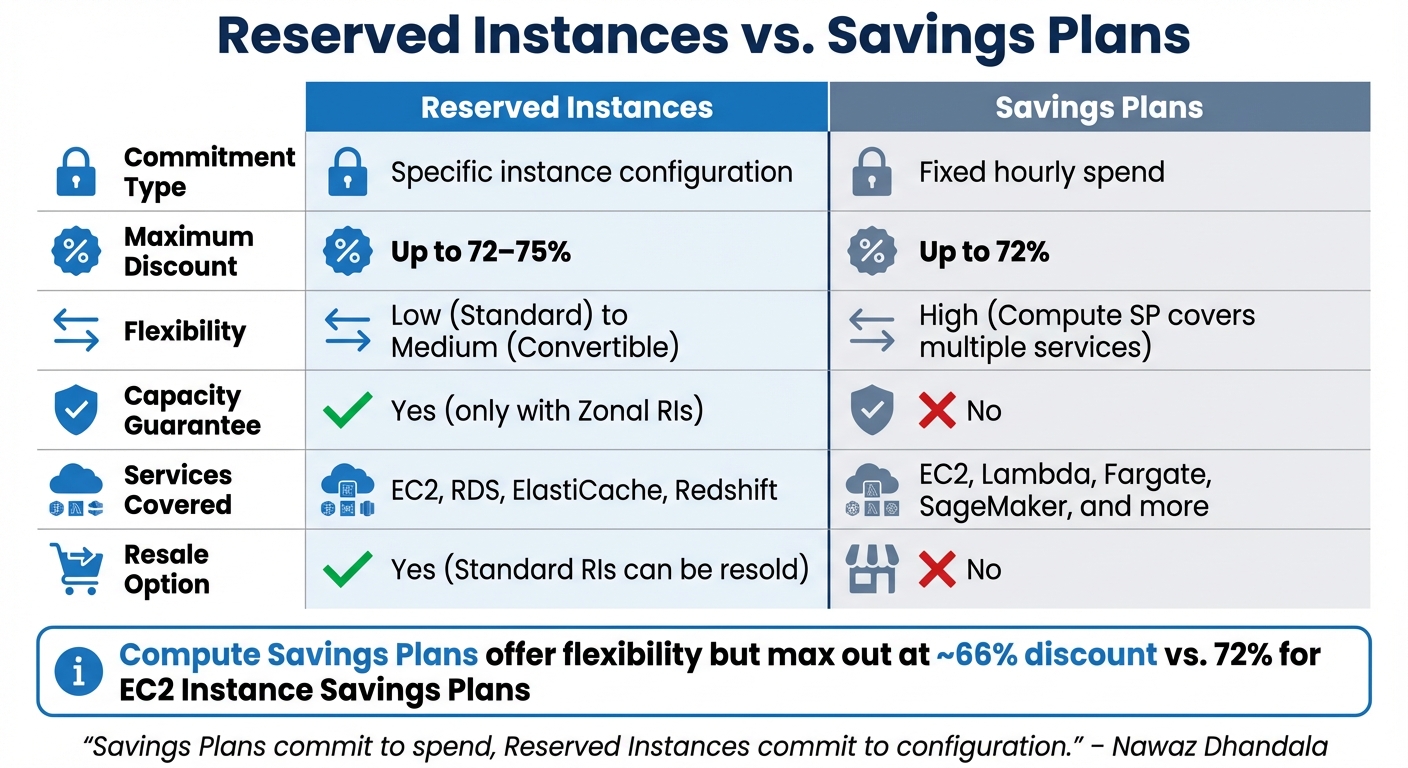
Reserved Instances vs Savings Plans: Features, Discounts, and Flexibility Comparison
Cloud commitments offer businesses a way to trade upfront usage promises for lower costs, making them a powerful financial tool. Instead of paying full price for infrastructure on a pay-as-you-go basis, companies can commit to a certain level of usage – either by reserving resources or pledging a fixed hourly spend. In return, providers offer discounted rates.
Reserved Instances (RIs) require a commitment to a specific configuration, while Savings Plans (SPs) allow you to commit to a fixed hourly spend – like $10/hour – with discounts automatically applied to eligible services. Both options come with flexible payment terms: All Upfront for the biggest savings, Partial Upfront for a balanced approach, or No Upfront to maintain cash flow, with discounts varying accordingly.
"Savings Plans commit to spend, Reserved Instances commit to configuration."
– Nawaz Dhandala
These commitments stabilize cloud costs, transforming unpredictable bills into fixed expenses that CFOs can plan around. For example, a one-year commitment typically breaks even after six months of full use, while a three-year term takes about nine months to recoup its cost. This predictability enables finance teams to forecast infrastructure expenses with greater accuracy.
AWS applies discounts in a specific order to maximize savings: Standard RIs first, followed by Convertible RIs, EC2 Savings Plans, and finally Compute Savings Plans. Additionally, both RIs and SPs can "float" across linked accounts, allowing unused capacity in one department to benefit others. However, only Zonal RIs guarantee capacity, which is essential for applications that need to scale instantly during traffic spikes.
This financial approach to cloud costs lays the groundwork for understanding how these commitment plans operate in practice.
How Commitment Plans Work
To effectively manage cloud costs, it’s critical to understand how commitment plans function. These plans require a precise forecast of your baseline infrastructure needs, locking in that capacity at discounted rates. The key is to commit only to your stable baseline – typically defined as the 10th percentile of hourly usage over a 90-day period.
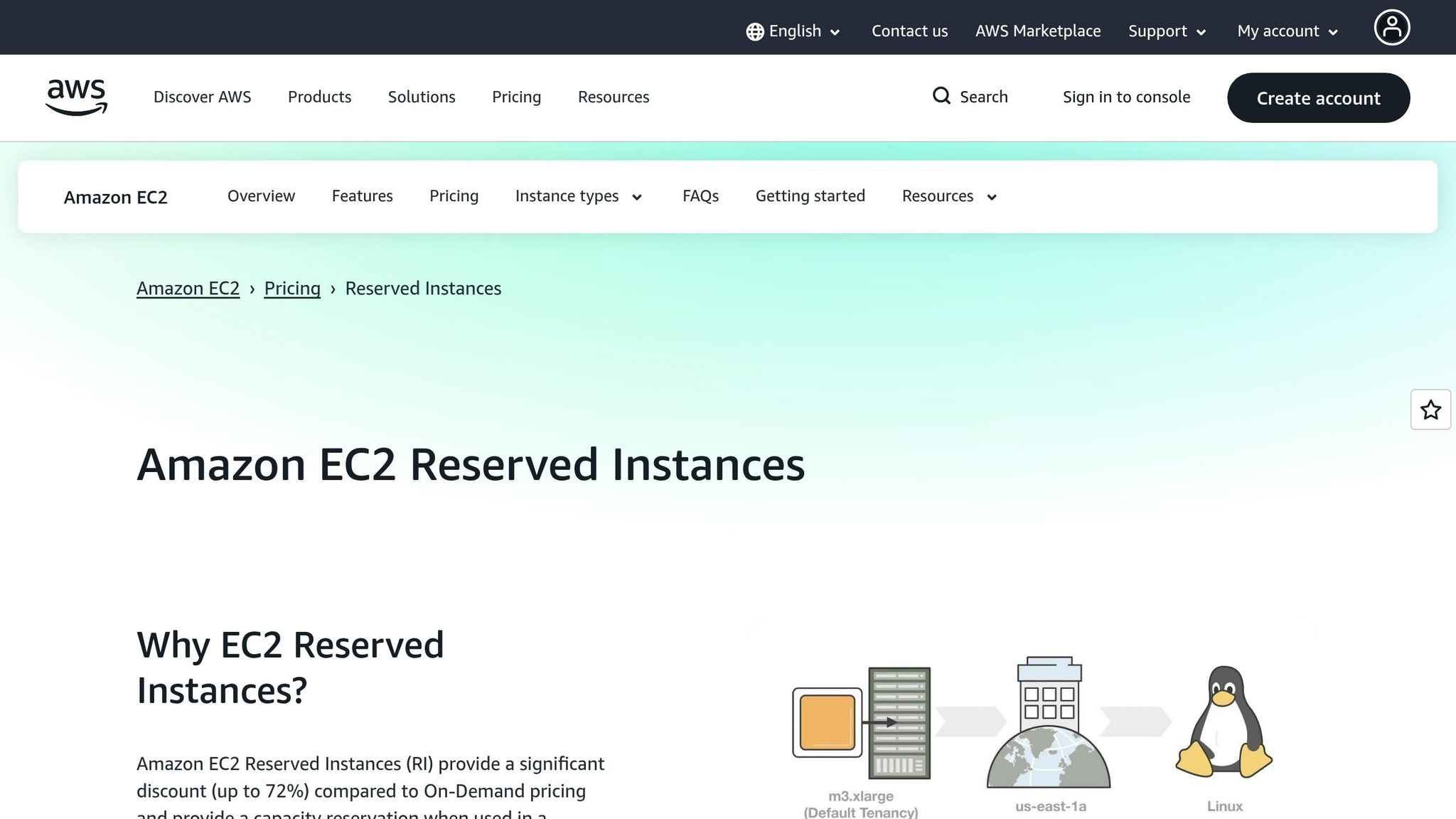
The timing of payments directly affects both your discounts and cash flow. All Upfront payments offer the highest savings – up to 75% for three-year Standard RIs – but require full payment upfront. Partial Upfront splits the cost, with half paid initially and the rest billed monthly. No Upfront spreads payments over time but comes with slightly smaller discounts.
The length of the commitment also impacts savings and flexibility. While three-year commitments provide deeper discounts, they carry the risk of locking into outdated configurations if your needs evolve. A layered strategy can help: use three-year commitments for core, stable usage and one-year commitments for additional predictable workloads.
Savings Plans require full hourly utilization to maximize their benefit. Standard RIs, on the other hand, offer an exit strategy since unused capacity can be resold on the AWS RI Marketplace.
Reserved Instances vs. Savings Plans
While both Reserved Instances and Savings Plans offer discounts, they differ in flexibility and how commitments are structured. Here’s a quick comparison:
| Feature | Reserved Instances | Savings Plans |
|---|---|---|
| Commitment Type | Specific instance configuration | Fixed hourly spend |
| Maximum Discount | Up to 72–75% | Up to 72% |
| Flexibility | Low (Standard) to Medium (Convertible) | High (Compute SP covers multiple services) |
| Capacity Guarantee | Yes (only with Zonal RIs) | No |
| Services Covered | EC2, RDS, ElastiCache, Redshift | EC2, Lambda, Fargate, SageMaker, and more |
| Resale Option | Yes (Standard RIs can be resold) | No |
Savings Plans are particularly useful for dynamic environments. Compute Savings Plans, for example, adapt automatically when switching instance families (e.g., M5 to M6) or moving from EC2 to serverless tools like Lambda and Fargate. However, this flexibility comes with slightly smaller savings – Compute SPs typically max out at around 66%, compared to 72% for more restrictive EC2 Instance Savings Plans.
"The benefit of the AWS savings plans model is its inherent flexibility, making it a low‐friction choice for modern, dynamic cloud environments."
– Stephen Lucas, Chief Product Officer, Hyperglance
For mission-critical workloads, capacity guarantees are essential. Only Zonal RIs provide guaranteed capacity in specific Availability Zones. If your application must scale instantly during peak demand, Zonal RIs are the best choice. Savings Plans, while flexible, don’t reserve capacity and should be paired with On-Demand Capacity Reservations when guarantees are required.
For predictable production workloads, EC2 Instance Savings Plans or Standard RIs are ideal for maximizing discounts. Compute Savings Plans, on the other hand, are better suited for development environments or multi-service architectures. For AI workloads, SageMaker Savings Plans can cut costs by up to 64% on both training and inference instances.
"The biggest mistake people make is over‑committing… Commit to 80% of that minimum, not the average."
– Nawaz Dhandala
AWS has added new features to reduce commitment risks. As of March 2024, Savings Plans with hourly commitments of $100 or less come with a 7-day return window, offering a safety net for sizing errors. For larger commitments, the AWS Purchase Analyzer (updated November 2024) helps model how new purchases will interact with existing RIs. Additionally, Queued Savings Plans allow businesses to schedule future commitments up to three years in advance, ensuring no gaps that could lead to higher on-demand rates.
Building a Cost Predictability Model
Cloud spending can feel like a rollercoaster – it fluctuates month-to-month based on usage. For CFOs, this variability makes forecasting tricky and budgeting even harder. That’s where commitment plans come in. They transform unpredictable infrastructure costs into fixed, recurring expenses, making financial planning far more straightforward.
The impact is pretty striking. Companies where Finance and Engineering collaborate on cloud cost management are twice as likely to achieve highly predictable forecasts – defined as less than 5% monthly variance. Why does that matter? CFOs with this level of accuracy are 2.8 times more likely to improve gross margins.
"Forecast precision is margin insurance. CFOs with <5% monthly variance are 2.8x more likely to improve gross margins."
– Cloud Capital
To build a cost predictability model, start by identifying a stable baseline of usage and structuring commitments around it. A 60-30-10 strategy works well: dedicate 60% of your budget to long-term commitments for steady workloads, 30% to medium-term commitments for specific projects, and 10% to short-term on-demand capacity. This method strikes a balance between securing discounts and staying flexible as your business evolves.
The payment structure you choose also plays a big role in cash flow. No Upfront commitments spread costs into fixed monthly payments, preserving liquidity. Partial Upfront options require some initial payment but combine it with monthly charges. All Upfront offers the biggest savings but requires full payment upfront.
Converting Variable Costs into Fixed Expenses
One way to stabilize costs is by committing to a fixed hourly spend for a one-year or three-year term. Any usage within this commitment is billed at a discounted rate, while anything above it is charged at regular on-demand rates. This shift turns cloud spending into a predictable fixed expense that’s easier for finance teams to manage.
Start by identifying your "stable floor" – the baseline capacity your business always needs. To find this, use the 10th percentile (P10) of hourly usage over a 60- to 90-day period. This approach focuses on your lowest usage periods rather than averages or peaks.
"Commitments should be based on what you always use, not what you use during peak events."
– Hari Chandrasekhar, Content Writer, Sedai
A good rule of thumb is to commit to only 80% of that baseline. This leaves room for optimization or unexpected changes. Keep in mind, unused commitment hours don’t roll over – if you don’t use them, they’re gone.
For companies with diverse workloads, tiered commitments can be a game-changer. Take the example of a financial services firm that reduced costs from $8.1 million to $5.4 million by organizing commitments across 47 AWS accounts and 12 Azure subscriptions. This approach not only saved $2.7 million annually but also improved budget variance from 47% to 12%.
Once your commitments are in place, the next step is to calculate when they’ll start paying off.
Calculating Break-Even Points and Savings
Fixed commitments don’t just make costs predictable – they also unlock savings after the break-even point. To figure out when that happens, use a simple formula:
Break-even hours = Upfront cost ÷ Hourly savings rate.
For example, if you spend $14,040 upfront for a one-year All Upfront commitment that saves $105 per hour compared to on-demand pricing, your break-even point is just 134 hours. Since a year has 8,760 hours, you’d recover your investment within 1.5% of the term, leaving the rest – 98.5% – as pure savings.
The payment structure you choose also impacts ROI. While All Upfront payments offer the largest discount percentage, Partial Upfront often delivers a higher ROI because less capital is tied up initially. For instance, in a three-year commitment, Partial Upfront provides a 61.5% ROI, compared to 41.7% for All Upfront, even though All Upfront offers a deeper discount (40% vs. 35%).
Here’s a quick breakdown:
| Payment Option | Term | Discount | Upfront Cost | Monthly Cost | Total Savings | ROI |
|---|---|---|---|---|---|---|
| 1-Year Partial Upfront | 1yr | 20.0% | $7,200 | $600 | $900 | 12.5% |
| 1-Year All Upfront | 1yr | 22.0% | $14,040 | $0 | $1,260 | 9.0% |
| 3-Year Partial Upfront | 3yr | 35.0% | $17,550 | $488 | $10,800 | 61.5% |
| 3-Year All Upfront | 3yr | 40.0% | $32,400 | $0 | $13,500 | 41.7% |
To ensure your plan stays on track, monitor utilization rates monthly. If resources are underused, the effective discount drops, potentially leading to a negative ROI. AWS even offers a 7-day return window for commitments under $100 per hour, giving you a safety net for early forecasting errors.
Finally, for accurate financial modeling, spread upfront costs across the contract’s duration. This ensures your profit and loss statements reflect the actual monthly infrastructure costs, not just the timing of cash payments. This approach supports better financial forecasting and helps CFOs improve margins.
Balancing Cost Savings with Growth Flexibility
When managing cloud costs, it’s not just about cutting expenses – it’s about balancing savings with the ability to scale and adapt. While long-term commitments can reduce costs, they can also limit flexibility. For CFOs, this presents a challenge: how do you secure savings without locking yourself into a rigid structure that can’t adapt to changing business needs, whether it’s rapid growth or a strategic shift?
The answer isn’t an either/or decision. Instead, it’s about blending both savings and flexibility into your strategy. A layered approach works best: lock in savings for steady, predictable workloads while using flexible options to handle fluctuating demands. This way, you can achieve cost efficiency without sacrificing the ability to adapt.
"Cloud commitments don’t fail because the math is wrong. They fail when teams chase flexibility instead of designing for it."
– Udi Limor, FinOps Engineer, 2bcloud
Start by committing to 70–80% of your baseline usage – the portion of your compute spend that remains consistent day in and day out. This approach provides a safety net, ensuring you don’t over-commit while capturing substantial savings. The remaining 20–30% can be left for on-demand pricing or spot instances, which are ideal for handling traffic spikes, experimental workloads, or variable demands. Companies using this method often see 92–97% utilization rates and 65–75% coverage rates.
Using Reserved Instances and Savings Plans Together
Combining Reserved Instances (RIs) with Savings Plans offers a way to optimize both savings and flexibility. For your most predictable workloads – those that make up 40–50% of your infrastructure – use Standard Reserved Instances or EC2 Instance Savings Plans, which can deliver discounts of up to 72%. Then, layer Compute Savings Plans over the next 30–40% of usage. These plans allow flexibility across instance families, regions, and services like Fargate and Lambda, offering savings of up to 66%.
That 6% difference in savings reflects the cost of flexibility. For example, with a $50,000 monthly compute spend, this gap could amount to around $108,000 over three years. Finally, for the remaining 15–30% of your capacity – where workloads are less predictable – stick with spot instances or on-demand pricing to maintain agility.
To reduce the risk of over-committing, consider purchasing commitments in monthly increments of about 20%. This dollar-cost-averaging strategy helps you adjust as your growth trajectory changes, making it especially useful for companies experiencing rapid expansion.
This hybrid strategy naturally leads to ways to mitigate over-commitment risks as your business evolves.
Managing Over-Commitment Risk
As your business grows and changes, the risk of over-committing becomes a key consideration. Over-commitment happens when you pay for capacity you don’t use, and since commitments operate on a "use it or lose it" basis, unused hours don’t carry over.
To manage this, Convertible Reserved Instances allow you to reconfigure your commitments without losing discounts. For example, if you’re planning a migration to Graviton processors, Convertible RIs give you the flexibility to adapt without forfeiting savings. On the other hand, Standard RIs can be resold in the AWS Marketplace if your capacity needs change.
Monitoring two critical metrics – utilization and coverage – is essential to avoid over-commitment. If your utilization rate falls below 80%, it’s a sign you’ve over-committed and should pause on purchasing additional plans. On the flip side, if utilization exceeds 99% but coverage is under 80%, you may have room to add more commitments. Ideally, mature FinOps teams aim for utilization and coverage rates between 85% and 98%.
Managing Commitments Across Multiple Accounts and Cloud Providers
Operating across multiple AWS accounts or juggling several cloud providers can quickly become a logistical challenge. Without a clear plan for allocating resources, some teams end up paying full on-demand rates while unused commitments pile up elsewhere. Data shows that high-performing organizations allocate over 95% of cloud usage to specific owners, and those with mature cost allocation practices act 32% faster when implementing cost-saving measures. Achieving this requires a combination of centralized oversight and precise cost attribution to the teams actually using the resources.
A good starting point is centralized management. Using a payer account in AWS Organizations, you can distribute Reserved Instance and Savings Plan benefits across all member accounts. This setup helps balance usage fluctuations – when one team’s needs drop, another team’s spike can absorb the unused capacity. But centralization alone isn’t enough. To ensure fairness and accuracy, costs must be mapped back to the teams consuming the resources. Instead of relying on raw on-demand rates, use amortized "effective cost" to reflect the actual discounted rates. This approach aligns internal billing with real usage, avoiding inflated costs.
"You don’t need complex models. You need consistent ones. The best driver is the one your teams already understand and trust."
– Rob Martin, FinOps Architect, Adobe
Distributing Commitments Across Teams and Accounts
Centralized management is just the first step. To maximize efficiency, commitments should also be aligned with specific teams. AWS offers Group Sharing options designed to fit different business structures. Here’s how they work:
- Prioritized Group Sharing: Commitments are applied to defined groups first, with unused capacity shared across the organization. This option works well when business units purchase their own commitments but want to avoid waste.
- Restricted Group Sharing: Commitments stay within specific groups, ideal for organizations like public sector entities or grant-funded projects with strict budgets.
- Standard Sharing: The default setting applies discounts to accounts receiving the highest savings first, ensuring maximum overall savings.
To make this system effective, consider implementing weekly showback reports. These reports hold engineering teams accountable for how they utilize purchased commitments. Additionally, standardizing instance families across the organization can improve the efficiency of size-flexible Reserved Instances and Savings Plans. When teams use a wide variety of instance types, commitments become fragmented, reducing utilization. These practices transform cloud commitments into tools for predictable costs and sustainable growth.
Pooling Commitments in Multi-Cloud Setups
As organizations expand their cloud usage, managing commitments across multiple providers becomes increasingly important. On average, enterprises use 2.4 cloud providers, which complicates billing and can lead to missed savings if not managed properly. The key is to normalize billing data from AWS, Azure, and GCP into a single, unified view. This includes standardizing metadata – mapping AWS "tags" to GCP "labels" – so costs are consistently attributed to the same business units across platforms.
A hybrid ownership model often works best in these scenarios. A centralized team can handle stable, shared usage, while decentralized teams manage experimental or rapidly changing workloads. This ensures that the bulk of infrastructure benefits from negotiated discounts without creating bottlenecks. With approximately one-third of cloud spend wasted, often due to poor visibility, consolidating your reporting across providers can directly improve financial outcomes.
Reinvesting Savings into Growth
Cloud commitments do more than cut costs – they free up budget capacity for strategic investments. By converting fluctuating infrastructure expenses into fixed, discounted rates, CFOs can redirect the difference between old on-demand pricing and new commitment pricing into growth initiatives. The real challenge lies in accurately measuring these savings and deploying them effectively.
Measuring and Tracking Savings
To make the most of these savings, precise measurement is crucial. It’s not just about tracking total spend – it’s about understanding unit economics like cost per transaction, active user, or API request. For instance, in September 2025, Nubank’s FinOps Leader Mike Rosenberg adopted this approach, focusing on "cost per thousand transactions" as the company scaled to add 5 million new customers per quarter. This method helped distinguish between growth-driven expenses and inefficiencies, ensuring infrastructure costs grew in step with revenue.
"For us, cost is job five. Engineers are never asked to prioritize cost-saving measures over more critical objectives such as security, regulatory compliance, system stability, and exceptional customer service."
– Mike Rosenberg, FinOps Leader, Nubank
Four key metrics help evaluate the return on investment (ROI) from commitments:
- Coverage percentage: Measures how much of your total usage benefits from discounts.
- Utilization percentage: Tracks whether you’re paying for unused capacity.
- Realized savings percentage: Reflects the actual dollar value saved – typically the difference between on-demand rates and what you paid.
- Forecast accuracy: Assesses your ability to predict future usage, minimizing the risk of over-commitment.
Collaboration between Finance and Engineering teams can significantly improve forecast accuracy. Teams that work together see 31% achieving forecast variances under 5%, compared to only 16% when Engineering operates independently.
Funding Growth with Infrastructure Savings
Once tracked, these savings can be reinvested to fuel growth. Optimizing cloud usage creates strategic capital, and the impact can be enormous. Research from a16z shows that every dollar saved in cloud efficiency can lead to a 25X increase in market cap for public SaaS companies. This makes infrastructure savings one of the most impactful investments a CFO can make.
Take Alphabet as an example. In February 2025, the company increased its capital expenditures to $52.5 billion for FY2024, up from $32.3 billion in 2023 – a 62% jump. This deliberate move redirected savings into AI and data center infrastructure to sustain market growth. Similarly, in March 2025, a leading European financial institution cut monthly infrastructure costs by 13% by shifting critical workloads to a colocation environment. This eliminated unpredictable egress fees and allowed them to reinvest in more robust infrastructure to meet EU compliance standards.
The 60-30-10 model offers a practical framework for reinvesting cloud savings. Here’s how it works:
- 60%: Allocated to long-term commitments for stable workloads, locking in deep discounts.
- 30%: Reserved for medium-term projects, like developing new product features.
- 10%: Kept flexible for rapid experimentation and seizing market opportunities.
This strategy avoids common pitfalls. While 73% of CFOs expect cloud spend to rise as a percentage of revenue, 69% find it "extremely challenging" to cut costs without affecting performance. By maintaining a 10% buffer, engineering teams can continue rolling out new features without delays caused by budget approvals, ensuring smoother forecasting and steady growth.
Conclusion: Making Cloud Commitments Work for Your Business
Cloud commitments go beyond simply cutting costs – they serve as a financial planning tool that helps create predictable budgets and frees up resources for growth. By turning cloud expenses into planned investments, businesses can better support scalable growth. The key to avoiding wasted spending lies in three strategies: sizing conservatively, diversifying your approach, and aligning Finance with Engineering.
Start by sizing your commitments based on reliable baseline usage. Focus on the 10th percentile of hourly usage, which represents your stable minimum, to avoid overcommitting and paying for unused capacity. It’s much easier to scale up commitments later than to deal with the costs of over-purchasing. Keep in mind that unwinding excess commitments comes with both termination fees and lost opportunities.
"Over-committing is the number one mistake teams make with RIs. You can always buy more later, but unwinding an over-purchase costs you the early termination fee and the opportunity cost of capital."
– Blaze, CloudCostChefs
A 60-30-10 strategy can help balance stability and flexibility. Allocate 60% of commitments to long-term stable workloads, 30% to medium-term projects, and 10% to short-term needs. This approach secures significant discounts while maintaining the agility to adapt. Additionally, fostering collaboration between Finance and Engineering is critical. Teams that work together achieve nearly double the forecast accuracy, with 31% of collaborative teams hitting less than a 5% variance, compared to just 16% when Engineering works alone.
To sustain these benefits, proactive monitoring is essential. Set utilization alerts at 80–90% and conduct quarterly reviews to identify underutilized resources before they impact your budget. Regularly revisit and adjust your commitments to align with changing business demands. By staying vigilant and flexible, your cloud strategy can continue to drive financial and operational success.
FAQs
How do I choose between Reserved Instances and Savings Plans?
Reserved Instances (RIs) work best for workloads that are steady and predictable. They involve committing to specific instance types, sizes, and regions for either 1 or 3 years. In return, you can save up to 75% compared to on-demand pricing.
On the other hand, Savings Plans offer greater flexibility. Instead of locking into specific instances, you commit to spending a set dollar amount per hour over 1 or 3 years. This approach accommodates different instance types and regions, making it a better fit for workloads that are more dynamic or likely to change over time.
What’s the safest way to size a cloud commitment for a fast-growing SaaS?
To manage costs effectively, it’s wise to begin with a cautious commitment level, covering about 50-70% of your steady-state compute needs. Pair this with automated tools for budgeting and anomaly detection to keep a close eye on usage trends. By regularly analyzing workload patterns and adjusting commitments, you can strike a balance between avoiding over-commitment and under-commitment, all while keeping costs aligned with your growth goals.
How should we account for upfront commitment costs in our P&L?
When dealing with upfront commitment costs, these should be recorded as prepaid assets and then gradually amortized over the duration of the commitment. This approach is consistent with standard accounting practices for managing long-term commitments.
By allocating the expense evenly across the commitment period, your profit and loss statement (P&L) accurately reflects the cost during the time it delivers value. This ensures financial reporting stays precise and aligns expenses with the benefits they provide.