AWS announces 15% GPU pricing increase, ending two-decades-long trend
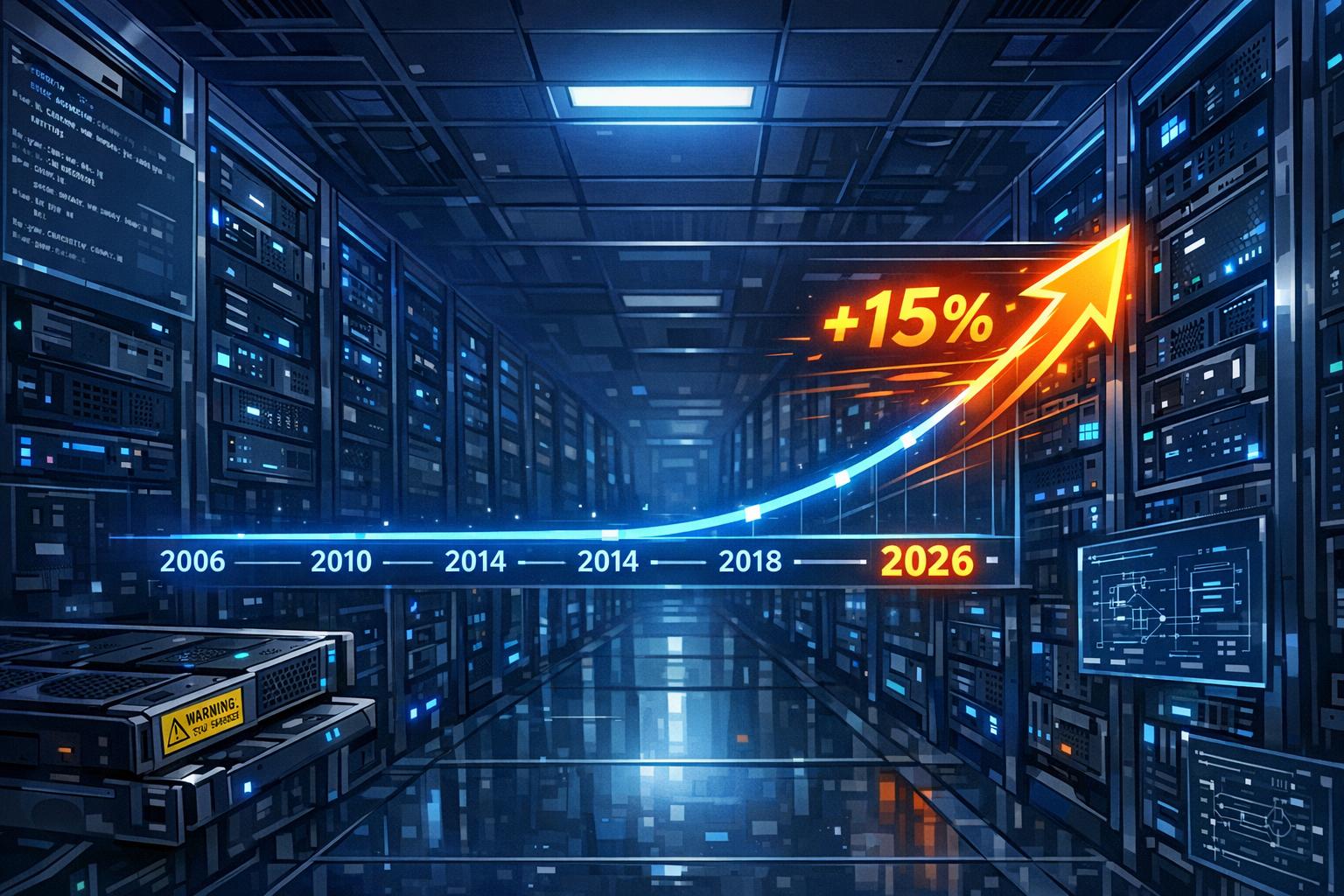
In an unprecedented move, Amazon Web Services (AWS) has raised the cost of its GPU-based EC2 Capacity Blocks for machine learning workloads by 15%, marking the first price increase in the company’s 20-year history. The adjustment, implemented on January 4, 2026, was made without advance notice to customers, breaking a long-standing trend of consistent price reductions that AWS had maintained since its inception.
The price for the p5e.48xlarge instance, which includes eight NVIDIA H200 GPUs, increased from $34.61 per hour to $39.80 per hour across most regions. AWS has indicated that the next pricing review is scheduled for April 2026. This change challenges the fundamental assumption that cloud operational costs will continually decrease, an expectation that AWS itself cultivated over the past two decades.
"AWS has spent two decades conditioning customers to expect prices only ever go down. That expectation is now broken. The precedent is set. That’s the part that matters. Once the door is open, it doesn’t close", said cloud cost expert Corey Quinn.
Industry-wide cost pressures drive price increases
The AWS price hike reflects broader cost pressures that are impacting the entire cloud computing industry. A global shortage of NVIDIA H200 GPUs is one of the main drivers. Chinese technology firms alone have reportedly placed orders for 2 million units, far exceeding the available stock of approximately 700,000. Compounding the issue, TSMC, the primary manufacturer of these chips, is prioritizing production of next-generation Blackwell and Rubin architectures, further straining the supply of H200 units. Current demand for the H200 GPUs surpasses supply by a ratio of 3:1.
Rising memory costs have also contributed to the pricing challenges. According to TrendForce, the cost of DDR4 memory has climbed by 158%, while DDR5 memory prices have surged by an alarming 307% since September 2025. This spike is attributed to manufacturers focusing on high-bandwidth memory (HBM) production for AI accelerators instead of standard server memory, creating a shortage for traditional infrastructure components.
Energy costs have further exacerbated the issue, with power expenses now accounting for 40-60% of data center operating budgets. In the PJM power market, which spans from Illinois to North Carolina, energy prices have skyrocketed from $34 per megawatt-day in 2023 to $329 in 2026 – an 868% increase. New data center demand alone added $9.3 billion in additional capacity costs for 2025-2026.
These challenges are not unique to AWS. Other major cloud providers, including Google Cloud and Microsoft Azure, face similar structural cost pressures. OVH Cloud CEO Octave Klaba has already predicted price increases of 5-10% across all cloud providers by mid-2026, driven by hardware cost inflation of 15-25%. While AWS has moved first by increasing GPU pricing, it is widely expected that competitors will follow suit.
sbb-itb-f9e5962
FinOps adoption surges as enterprises seek cost control
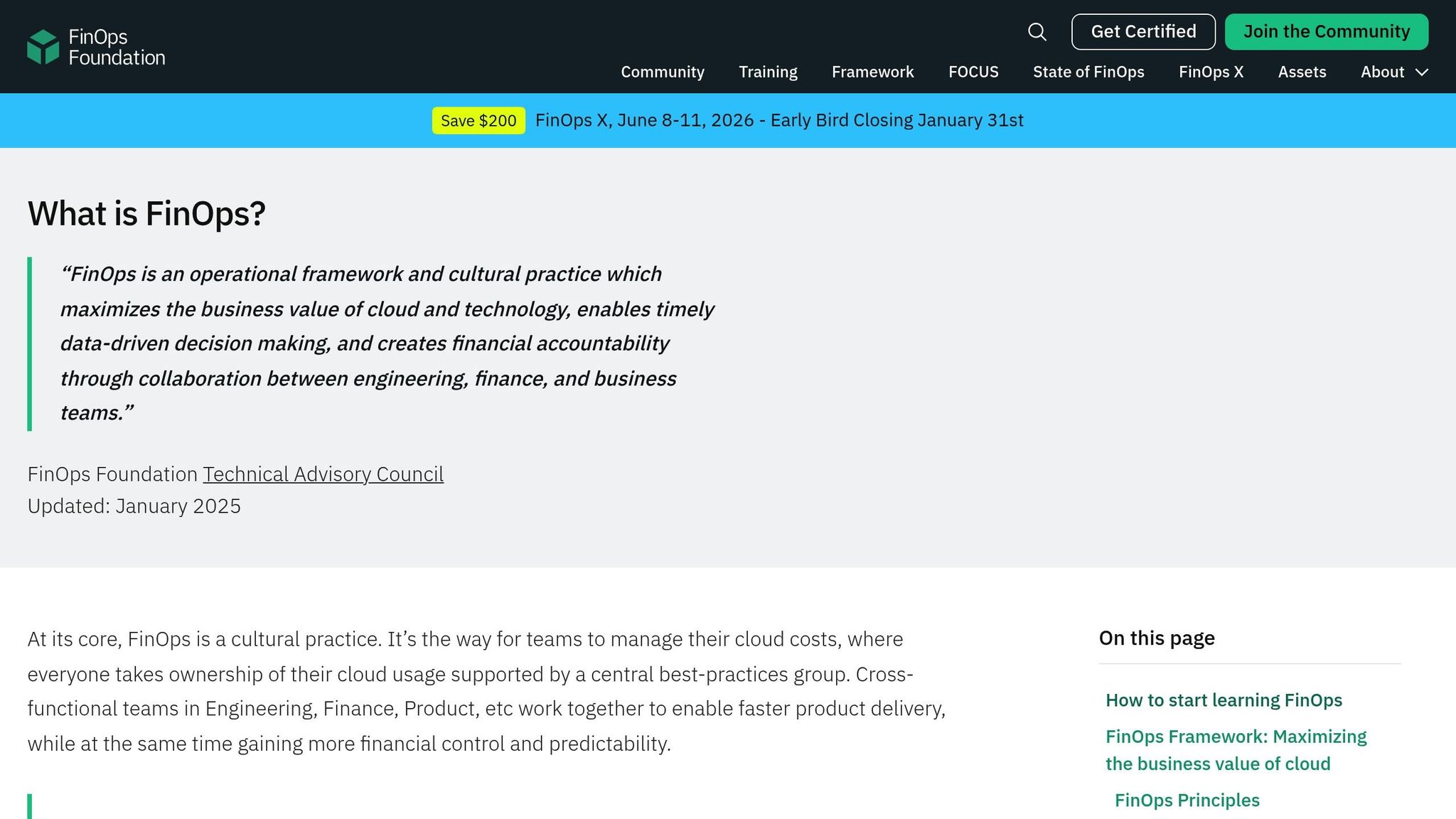
The AWS decision to increase prices underscores a broader shift in how businesses approach cloud cost management. FinOps, a financial operations framework designed to optimize cloud spending, is gaining significant traction. By 2026, 75% of enterprises are expected to adopt FinOps practices, up from 46% the previous year. Structured FinOps programs have proven effective, with organizations achieving cost reductions of 25-30% and realizing returns of 10-20x on their investment.
"The math shifted when cloud providers started raising prices. For 20 years, enterprises could tolerate waste because baseline costs declined annually. That buffer disappeared. When AWS can raise prices 15% on a Saturday, FinOps shifts from cost optimization to business continuity", the source article noted.
Many organizations have found significant savings by addressing predictable areas of cloud waste. These include idle resources, which can account for 10-15% of monthly invoices, over-provisioned compute (10-12% waste), and orphaned storage artifacts (3-6% avoidable spend). Automation tools such as ProsperOps and IBM Turbonomic are helping businesses monitor and optimize their cloud costs in real time, making these tools indispensable in an era of pricing volatility.
Enterprises turn to hybrid and multi-cloud strategies
The sudden price hike has accelerated discussions about strategic changes to cloud infrastructure. Cloud repatriation – the process of moving workloads from public clouds to on-premises or private cloud environments – is becoming an increasingly popular option. According to IDC, 83% of enterprise CIOs plan to repatriate at least some workloads, though only 8% are considering a complete departure from public clouds. The focus is on optimizing workload placement based on cost and operational requirements rather than abandoning the cloud entirely.
For high-utilization AI workloads, running on-premises infrastructure is proving to be significantly more cost-effective. Eight H200 GPUs, which cost $240,000-$320,000 to purchase outright, amortize to $15-20 per hour over three years of continuous use. In comparison, AWS now charges $39.80 per hour for the same resources following the price hike. However, cloud services remain the superior option for workloads with variable demand, as organizations cannot purchase partial GPU clusters for short periods.
Hybrid architectures are emerging as the default approach, combining the cost efficiency of on-premises systems for predictable workloads with the flexibility of the cloud for bursts and experimentation. Multi-cloud strategies are also gaining traction, allowing enterprises to compare pricing between providers like AWS, Google Cloud, and Azure and shift workloads accordingly. Kubernetes, a widely used container orchestration platform, is enabling greater portability and flexibility for organizations adopting these strategies.
Key takeaways for businesses
The AWS price increase signals a fundamental shift in the economics of cloud computing, requiring businesses to adapt their strategies accordingly. To mitigate the effects of rising costs, enterprises are advised to:
- Adopt FinOps automation: Implement real-time cost monitoring and optimization tools to manage pricing volatility effectively.
- Lock in long-term savings plans: Secure fixed rates before on-demand prices potentially rise further in 2026.
- Design for multi-cloud portability: Avoid single-provider lock-in by developing infrastructure that can be easily migrated across platforms.
- Reevaluate cloud vs on-premises costs: For workloads with utilization rates exceeding 70%, on-premises solutions may offer significant savings compared to cloud services.
As the precedent for rising cloud prices has now been set, enterprises must approach cloud economics with greater scrutiny and flexibility. Those that proactively adopt strategies like FinOps, hybrid architectures, and multi-cloud frameworks will be better positioned to weather the shifting landscape of cloud computing. For others, assuming that prices will continue to decline may lead to unexpected – and costly – shocks.