How AI Reduces Cloud Waste

Cloud waste is a growing issue, with U.S. businesses losing 20–30% of their cloud budgets to unused or idle resources. For a company spending $1 million monthly, this equates to $2.4–$3.6 million annually in wasted costs. AI can help by analyzing cloud usage data in real time, identifying inefficiencies like idle virtual machines, overprovisioned instances, and unattached storage, and recommending or automating optimizations. Companies using AI-powered tools often reduce cloud expenses by 20–30% while maintaining system performance. This approach not only saves money but also simplifies resource management and improves reliability.
Key takeaways:
- Cloud waste sources: Idle resources, overprovisioning, unused storage, and misconfigurations.
- AI solutions: Rightsizing, predictive scaling, automated scheduling, and anomaly detection.
- Savings potential: $1 million+ annually for mid-sized organizations.
- Additional benefits: Improved cost visibility, reduced manual oversight, and streamlined operations.
AI-powered tools like TECHVZERO provide practical ways to cut costs and optimize cloud usage without sacrificing performance.
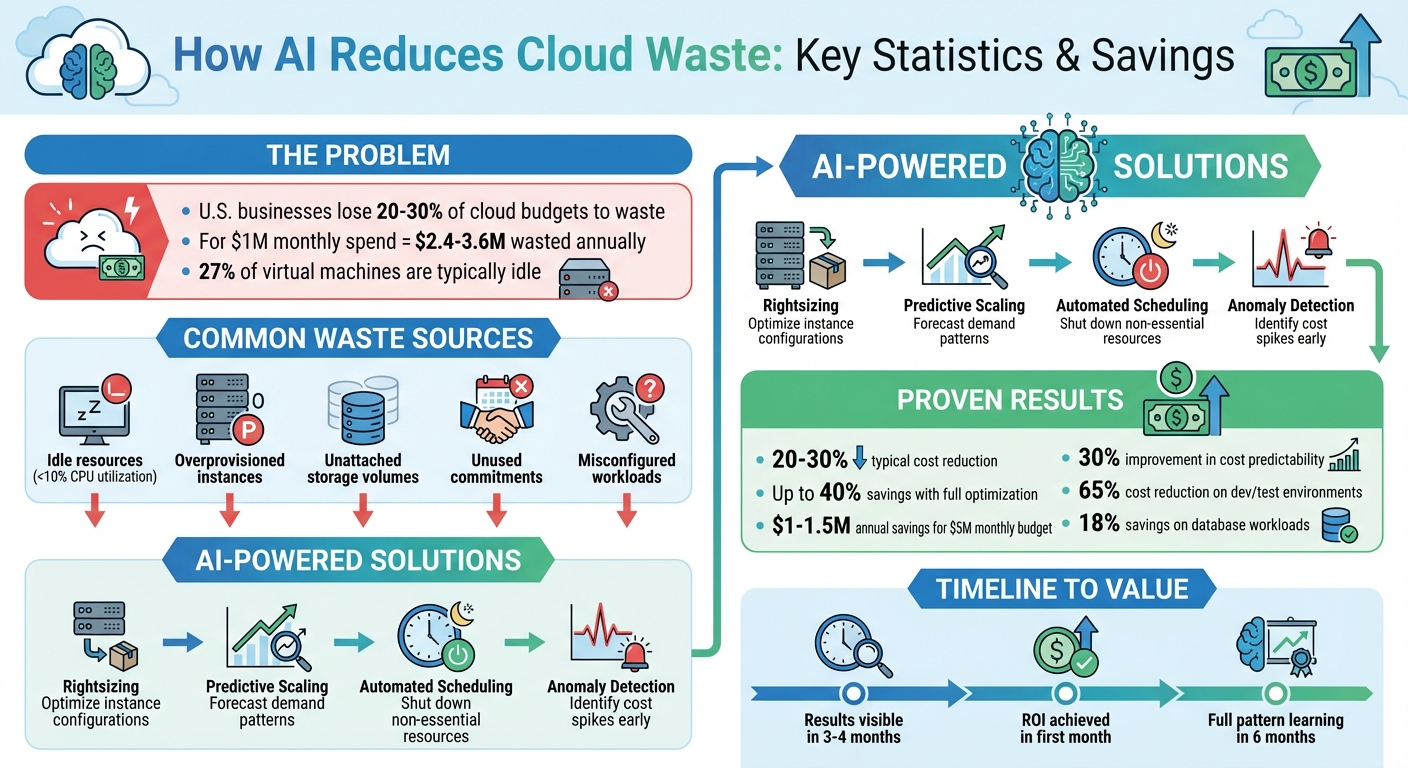
AI Cloud Waste Reduction: Statistics and Savings Potential
How Does AI Automate Cloud Cost Optimization And Prediction? – Cloud Stack Studio
What Is Cloud Waste and Why Does It Matter
Grasping the concept of cloud waste is key to tackling inefficiencies and making the most of AI-driven solutions.
At its core, cloud waste refers to recurring expenses in cloud environments that don’t deliver enough business value. This includes things like idle, overprovisioned, misconfigured, or forgotten resources. Cloud platforms are designed to be fast and flexible, allowing teams to spin up resources – like instances, storage, and services – whenever needed. However, this speed often comes at the expense of clear visibility and accountability, especially in dynamic, decentralized setups spanning development, testing, and production environments. Let’s break down some of the most common ways cloud waste occurs.
Common Types of Cloud Waste
Cloud waste takes many forms, and here are the most frequent culprits:
- Idle or lightly used compute resources (<10% CPU utilization): These are virtual machines, containers, or databases running around the clock but handling minimal workloads.
- Overprovisioned instances: When resources are sized far beyond what’s actually needed – often due to conservative estimates or unoptimized migrations.
- Unattached storage: Think orphaned volumes, snapshots, or backups left behind after a project ends. These quietly rack up charges without anyone noticing.
- Unused commitments: Reserved instances or savings plans that no longer align with current workloads, draining budgets unnecessarily.
- Misconfigured workloads: Poor autoscaling policies or mismatched instance types that result in over-allocation and inefficiency.
These forms of waste are well-documented and represent a large chunk of unnecessary cloud spending.
Financial and Operational Costs
Cloud waste doesn’t just dent budgets – it can derail entire strategies. The financial hit from wasted resources eats into funds that could otherwise go toward AI projects, product development, or improving customer experiences. Beyond the dollars and cents, cloud waste skews key metrics like cost per customer or transaction, making it harder for teams to make smart trade-offs. On the operational side, unused resources create vulnerabilities, complicate incident response, and force teams to waste time chasing down billing anomalies instead of focusing on system reliability.
These financial and operational headaches highlight why manual oversight often falls short.
Why Manual Management Doesn’t Work
Managing cloud resources manually is like trying to catch a waterfall with a bucket. With thousands of resources spread across multiple accounts and workloads that shift constantly, tracking costs in spreadsheets just doesn’t cut it. Human teams can’t keep up with the sheer volume of telemetry data – covering CPU, memory, network, storage, and logs – or untangle the complex pricing models and commitments from providers in real time. Static policies, like fixed instance sizes or rigid schedules, fail to adapt to real-world dynamics like seasonal demand or product launches, leading to either over- or under-provisioning. And as cloud usage grows, any delay in spotting and addressing cost spikes only allows waste to pile up.
These limitations are why more organizations are turning to AI-powered FinOps and automated tools to take control of their cloud spending. By doing so, they can manage resources efficiently and reduce waste without the constant need for manual intervention.
How AI Detects and Eliminates Cloud Waste
AI takes on the challenge of cloud waste by processing massive amounts of data in real time to uncover inefficiencies. Instead of relying on outdated monthly reports or rigid thresholds, AI continuously monitors telemetry data – like CPU usage, memory, storage I/O, and network activity – and compares it to historical patterns. This approach helps identify underused or idle resources on a large scale. For instance, AI might detect that 300 instances across various teams exhibit similar low-usage trends overnight. It can then suggest downsizing these instances and consolidating schedules, potentially saving around 35% on those resources. Such ongoing analysis forms the backbone of smarter detection strategies.
AI-Powered Detection Methods
AI uses machine learning models to establish baselines of what "normal" behavior looks like for workloads, drawing from historical data across different business cycles. These models actively compare current telemetry to those baselines, flagging underutilized resources. For example, a virtual machine running at consistently low CPU and memory levels or a storage volume left untouched for months would stand out. Anomaly detection plays a critical role here. Rather than waiting for a 50% cost surge to show up on a monthly bill, AI can spot even minor deviations – like a 5% increase – and provide prioritized recommendations. These recommendations estimate potential savings and outline the effort required to implement changes. One mid-sized tech company that adopted AI-driven optimization discovered that 27% of its virtual machines were idle. By shutting them down and rightsizing database workloads, the company improved efficiency and cut back on unnecessary resource use.
Dynamic Resource Optimization
Dynamic optimization takes things a step further by continuously adjusting compute, storage, and network resources based on real-time demand, moving away from static, worst-case capacity planning. AI makes this possible by predicting workload needs using historical trends, seasonal shifts, and specific events. It then automatically rightsizes instances, fine-tunes autoscaling policies, and adjusts storage tiers. For example, predictive scaling models can minimize overprovisioning during off-peak hours while ensuring enough capacity is available before traffic spikes, leading to about a 30% improvement in cost predictability. In Kubernetes environments, AI-driven tools can scale down pods during low-demand periods and fully empty nodes, eliminating costs tied to idle capacity. These systems are evolving into self-sufficient agents that continuously optimize multi-cloud environments without requiring manual intervention. This dynamic approach bridges technical actions with financial goals, ensuring resources are used efficiently.
Connecting Engineering and Finance Teams Through AI
AI also helps align technical and financial priorities by creating a shared understanding of cloud usage and costs. AI-powered FinOps platforms break down spending and usage by product, team, feature, and environment, giving both engineering and finance teams a detailed, unified view. These platforms translate technical metrics into financial terms – like cost per customer, API call, or feature – making it easier to connect engineering decisions to financial outcomes. They also prioritize optimization opportunities based on potential savings, required effort, and associated risks, helping teams align on a clear cost-saving roadmap. By forecasting future cloud expenses based on expected growth, AI enables finance teams to plan budgets in USD while providing engineers with data-driven guardrails instead of broad cost-cutting mandates.
AI Solutions That Reduce Cloud Waste
To effectively combat cloud waste, businesses need to go beyond simply identifying inefficiencies – they must take action. AI-powered tools offer practical solutions that transform insights into tangible cost savings. These tools not only help reduce spending but also maintain or even enhance system performance, all while eliminating wasteful practices without requiring manual effort.
Rightsizing and Scaling Resources
AI-driven rightsizing tools analyze how resources like CPU, memory, and network capacity are being used across various instances. By studying usage patterns, these tools can recommend cost-efficient configurations that might escape notice during manual reviews. Machine learning models take this a step further by forecasting future demand and enabling predictive scaling, which adjusts resource capacity to match anticipated needs. This dual approach – rightsizing and predictive scaling – can lead to a 20–30% reduction in cloud waste. For a mid-sized company with a $5 million monthly cloud budget, that’s an annual savings of $1–1.5 million.
For example, a healthcare organization applied AI forecasting to its workloads, improving cost predictability by 30% and cutting down on over-provisioning during off-peak hours. By learning from historical data, AI systems continuously refine their ability to predict resource needs, ensuring long-term efficiency gains.
Beyond rightsizing, AI also introduces automation for scheduling and cleaning up resources, further minimizing waste.
Automated Scheduling and Cleanup Policies
AI can enforce automated scheduling policies to shut down non-essential resources during off-hours. For instance, development and testing environments that only operate during business hours can be automatically paused overnight and on weekends. One company reduced costs by 65% on 100 test virtual machines in AWS simply by turning them off outside business hours.
In addition to scheduling, AI handles cleanup tasks like terminating idle storage, removing expired environments, and decommissioning underutilized virtual machines. In one case, a mid-sized tech firm discovered that 27% of its virtual machines were idle and identified over 40 duplicate SaaS licenses. By addressing these inefficiencies, they reduced database workload costs by 18%, saving more than $1.2 million annually – all without sacrificing performance.
Once resources are optimized and automated, AI can also step in to monitor and manage unexpected costs.
Cost Anomaly Detection and Response
AI-powered cost anomaly detection tools monitor cloud expenses in real time, quickly identifying unusual spending patterns. Unlike traditional methods that might take weeks to spot significant cost spikes, advanced AI can detect subtle increases – like a 5% rise – within hours. This early detection allows teams to address potential issues before they escalate into larger problems.
Predictive models go one step further by identifying irregular resource usage 24–48 hours before it impacts the budget. This proactive approach shifts financial operations (FinOps) from reacting to waste after the fact to preventing it entirely. AI platforms also prioritize optimization recommendations by evaluating factors such as return on investment (ROI), implementation effort, and risk level, ensuring that teams focus on the most impactful changes.
sbb-itb-f9e5962
How to Implement AI for Cloud Cost Optimization
Once you’ve identified and reduced cloud waste, introducing AI into the mix isn’t something that happens overnight. It requires a well-planned process, starting with a strong data foundation, seamless system integration, and ongoing performance tracking. Companies that follow this structured approach often see cost reductions of 20–30% within three to four months.
Building Your Data Foundation
The strength of AI lies in the quality of the data it processes. To optimize cloud costs, you need a clear picture of your cloud usage and spending. This involves gathering detailed telemetry data – like CPU, memory, network, and disk I/O – from all resources, as well as granular billing data broken down by service, region, and time period.
Many businesses struggle to achieve real-time visibility into their cloud spending, especially when managing complex multi-cloud setups or decentralized provisioning. To tackle this, start by establishing baseline metrics. Track your monthly cloud expenses in USD, measure average resource utilization, and calculate the percentage of idle resources. Additionally, enforce standardized tagging to identify key details like the responsible team, application, environment (e.g., production, staging, development), and cost center. These tags allow AI to accurately allocate costs and suggest specific optimizations.
For organizations with limited data engineering expertise, building reliable data pipelines can be a hurdle. In such cases, partnering with specialists can provide the infrastructure needed to supply AI models with consistent, high-quality data[11]. Once your data foundation is solid, the next step is to integrate AI into your existing workflows.
Integrating AI with Your Current Systems
With a reliable data foundation in place, the next move is to connect AI tools to your cloud management and DevOps systems. Start cautiously by using a read-only mode, where AI analyzes your data and provides recommendations without making any automatic changes. This approach lets your team review and verify suggestions before implementing them[11].
To make the process seamless, integrate AI recommendations into platforms your team already uses, such as Jira or Slack. This reduces friction and ensures that engineers can easily review and act on suggestions without switching tools. AI platforms often focus on a few high-impact changes that can lead to notable monthly savings.
A good example of this is TECHVZERO, which combines DevOps automation with advanced data engineering to optimize cloud costs effectively. Their approach includes setting up CI/CD pipelines that roll out changes safely through infrastructure-as-code, building continuous data pipelines for AI models, and fine-tuning those models to align with specific workloads and cost goals. This comprehensive integration ensures AI-driven recommendations lead to real savings without disrupting daily operations.
Before automating changes, it’s critical to set clear boundaries. Begin with low-risk actions, like shutting down non-production environments outside business hours or cleaning up unused storage volumes. For higher-impact changes, such as resizing production databases, require manual approval. Over time, as your team becomes more confident and the AI learns your usage patterns, you can gradually expand automation to include more complex optimizations. Once integrated, continuous monitoring and refinement are key to maintaining long-term savings.
Tracking Results and Metrics
To measure success, track both financial and operational metrics. Monitor your total monthly cloud spend in USD, broken down by business unit, team, or application. Calculate gross savings from AI-driven optimizations by comparing costs before and after implementation, and then determine net savings after factoring in tool and implementation expenses.
Assess resource utilization – such as CPU, memory, and storage – before and after optimization. Keep an eye on the percentage of idle resources eliminated and the number of rightsizing recommendations successfully applied. AI should also be capable of identifying unusual patterns 24–48 hours before they affect your bill, a significant improvement over traditional methods that often take weeks.
Set KPIs that align with your business objectives, such as cost per transaction, cost per API call, or cost per active user. Measure how quickly cost issues are detected and resolved, as well as the percentage of AI recommendations implemented. For example, one tech company reduced cloud waste by 40% in a year using predictive analytics to fine-tune resource allocation[11], while a healthcare provider cut cloud expenses by 35% while enhancing service delivery[11].
The key to success is treating AI as a system that continually learns and improves. Each optimization helps train the model, enabling it to make smarter predictions over time. Within about six months, AI can recognize your organization’s unique usage patterns and seasonal trends, leading to more precise, tailored recommendations. Track which suggestions are implemented, compare their actual impact to predictions, and document any unexpected results. This feedback loop ensures that the AI evolves alongside your business, without requiring constant manual adjustments.
Business and Environmental Benefits of Reducing Cloud Waste
Financial Returns
Cutting cloud waste isn’t just good for the environment – it’s a smart financial move. Many U.S. businesses can slash 20–30% of their cloud costs by tackling idle resources, resizing instances, and automating schedules. For a company spending $1,000,000 monthly on cloud infrastructure, this could translate to annual savings of $2.4–$3.6 million. Some organizations have even reported savings of up to 40% by fully leveraging predictive scaling and continuous optimization.
Take the example of a mid-size tech company using TECHVZERO’s solution in 2025. They discovered that 27% of their virtual machines were idle and promptly shut them down. In addition, they canceled over 40 duplicate SaaS licenses and optimized database workloads, saving 18% on those resources. Altogether, these efforts resulted in over $1.2 million in annual savings.
These savings don’t just pad the bottom line – they create opportunities. Companies can reinvest this money into innovation, product development, and market expansion. As one CFO highlighted:
"They cut our AWS bill nearly in half while actually improving our system performance. It paid for itself in the first month. Now we can invest that savings back into growing our business."
– CFO, Techvzero Client
On top of the financial benefits, these optimizations set the stage for better operational efficiency.
Improved System Performance
Reducing cloud waste doesn’t just save money – it also boosts system reliability. AI-driven autoscaling ensures resources are ready for traffic surges during business hours, product launches, or seasonal peaks. By scaling up resources proactively instead of reactively, companies can minimize downtime, speed up response times, and maintain consistent service quality.
Automation plays a crucial role here, too. Tasks like adjusting autoscaling rules, cleaning up unused resources, and managing predictable incidents are handled automatically, lightening the workload for IT and site reliability teams. One engineering manager at Techvzero shared how impactful this can be:
"They fixed our deployment pipeline in two days, enabling the team to deploy five times more frequently with zero drama."
– Engineering Manager, Techvzero Client
Companies embracing AI-powered operations often see a 30% drop in operational expenses, alongside fewer incidents and smoother performance overall.
Environmental Impact
Optimizing cloud operations doesn’t just help businesses – it helps the planet. Consolidating workloads and resizing resources reduces energy use and carbon emissions. With fewer servers and storage arrays running, data centers consume less power and require less cooling, cutting their carbon footprint.
As green cloud initiatives and provider dashboards become more common, U.S. companies can align their cost-saving efforts with sustainability goals. The same automation tools can support ESG reporting and help businesses work toward carbon neutrality. TECHVZERO’s approach, which combines DevOps automation with data engineering, ensures that these optimizations deliver tangible benefits for both budgets and the environment. This dual focus helps organizations meet their financial targets while advancing their sustainability objectives.
Conclusion
Wasting money on unused cloud resources is something no organization can afford. By using AI-powered tools, businesses can slash costs by 20–30%, improve reliability, and redirect budgets toward growth. These tools work by identifying usage patterns, optimizing resource allocation, and automating cleanups before unnecessary spending spirals out of control.
Companies adopting AI-driven FinOps strategies have reported annual savings of $2.4–$3.6 million on a $1 million monthly cloud spend. Some have even achieved reductions as high as 40% – a clear testament to the financial impact of these practices. These savings not only reduce expenses but also pave the way for smoother, more efficient operations.
The benefits go beyond just saving money. Automation powered by AI enhances workflows by reducing manual tasks, minimizing downtime, and introducing smart features like automated scheduling and autoscaling. On top of that, it supports sustainability goals by consolidating workloads, cutting energy use, and eliminating idle resources, which helps lower carbon emissions.
TECHVZERO leverages these AI-driven solutions to deliver real results. By combining DevOps automation, data engineering, and cloud cost optimization, they help organizations reduce waste, streamline deployments, and build a strong foundation for smarter operations. In just 90 days, TECHVZERO delivers tangible benefits like reduced costs, faster deployment times, and improved system performance.
FAQs
How does AI help reduce inefficiencies and cut costs in cloud usage?
AI is transforming how businesses manage their cloud environments by pinpointing inefficiencies. Through analyzing usage patterns, it identifies areas like underutilized resources, over-provisioned instances, or idle workloads. This helps organizations fine-tune their cloud infrastructure for better efficiency.
On top of that, AI takes automation to the next level by managing scaling and resource allocation. It ensures you’re only using – and paying for – what’s necessary. The result? Less waste, lower costs, and consistent performance without sacrificing reliability.
How can AI help lower cloud costs and reduce waste?
AI has the potential to trim down cloud expenses by pinpointing and resolving inefficiencies in how resources are used. By examining usage patterns and fine-tuning workloads, it ensures you’re only paying for what’s genuinely necessary – cutting out wasteful spending.
In fact, many companies report up to 40% savings within just three months of adopting AI-powered cloud optimization tools. And the benefits don’t stop at cost savings – AI also boosts system performance and reliability, making it a practical choice for achieving long-term operational efficiency.
How does AI help optimize cloud usage and reduce costs?
AI has become a game-changer in managing cloud operations by spotting inefficiencies like underused resources or systems with more capacity than needed. It goes a step further by suggesting ways to fix these issues, helping businesses reduce waste and save money.
Through analyzing usage trends and forecasting future demands, AI ensures resources are used wisely. This smart resource management not only keeps systems running smoothly but also aligns technical efficiency with financial goals, delivering cost savings without compromising performance.