How Predictive Insights Reduce Cloud Costs

Cloud costs are skyrocketing, but 80% of companies exceed their budgets due to inefficiencies. Predictive insights, powered by machine learning, offer a solution by forecasting future cloud needs and optimizing resource usage. Here’s why this matters:
- Wasted Cloud Spending: In 2022, idle assets cost $21.7 billion, over-provisioning added $13 billion, and 44% of resources sat idle 76% of the time.
- AI’s Role: Machine learning predicts resource needs with 91.7% accuracy (vs. 58.2% with older methods), helping companies save 20–40% on cloud bills.
- Real Results: Companies like Meesho and More Retail cut costs by up to 50% using AI-driven cost management.
Key Steps to Cut Costs:
- Collect and clean historical cloud usage data.
- Use machine learning models like ARIMA or DeepAR+ for cost forecasting.
- Monitor real-time anomalies to prevent budget overruns.
- Automate resource scaling to match predicted demand.
How Predictive Insights Work in Cloud Cost Optimization
What Are Predictive Insights?
Predictive insights are forecasts powered by artificial intelligence, designed to predict future cloud expenses and resource requirements. Unlike static reports, which rely on fixed data snapshots, these insights leverage machine learning models trained on historical data – like CPU, memory, storage usage – and market pricing trends to produce dynamic, real-time forecasts.
The process begins with a "Data Foundation" layer, where billing reports, resource utilization stats, and performance logs are normalized and tagged for analysis. Advanced algorithms, such as ARIMA, LSTM networks, and DeepAR+, then analyze workload patterns and seasonal fluctuations. These models also account for external business factors, such as marketing campaigns or product launches, to anticipate demand spikes.
What sets this approach apart is its continuous learning capability. Models compare predicted costs with actual spending, refining their accuracy over time through feedback loops. Additionally, unsupervised learning algorithms, like Isolation Forests, filter out anomalies – those one-off spikes or dips – that could otherwise distort future predictions. As emma.ms aptly states:
"The true value of predictions isn’t the data itself, but what you can do with it. By anticipating cost changes and resource needs, teams can sidestep budget overruns and avoid performance bottlenecks before they occur."
This comprehensive approach not only forecasts costs but also improves resource management and helps teams make more efficient use of their budgets.
Benefits of Predictive Insights for Cloud Costs
The use of predictive models translates into tangible benefits, including reduced costs and increased operational efficiency. By shifting from reactive to proactive cost management, organizations see measurable results: AI-augmented FinOps enhances anomaly detection accuracy to 92.5%, compared to just 63.7% with manual methods. Cost analysis becomes 68% faster, and businesses implementing predictive scaling often achieve 20% to 40% reductions in their cloud spending.
These insights identify inefficiencies such as over-provisioned instances, idle resources, zombie clusters, and orphaned volumes. Instead of over-provisioning to handle potential traffic spikes, predictive scaling allows systems to adjust capacity in advance based on anticipated demand. For instance, in 2025, the e-commerce platform Meesho optimized their EC2 instances using AI-based rightsizing. By scaling to 30 instances instead of the usual 50 during peak periods, they cut their monthly cloud spend from $10,000 to $7,000 – a 30% cost reduction.
The contrast between traditional and AI-driven approaches is striking. Traditional FinOps relies on outdated data, like last month’s bill, and fixed thresholds – essentially reacting to problems after they occur. On the other hand, AI-augmented FinOps uses historical patterns, market trends, and real-time indicators to predict and prevent issues before they arise. It’s the difference between putting out fires and ensuring they never start in the first place.
Steps to Implement Predictive Insights for Cloud Cost Reduction
Step 1: Collect and Analyze Historical Cloud Usage Data
Begin by gathering detailed billing reports like AWS Cost and Usage Reports (CUR), Azure Cost Analysis, or Google Cloud Billing exports. Pair these with utilization metrics – CPU, memory, storage capacity, and network transfer patterns – to get a clear picture of how your infrastructure behaves under different workloads. It’s essential to clean and standardize this data. Remove anomalies such as one-time purchases, deleted resources, or incomplete historical records. For multi-cloud setups, use ETL pipelines to unify data formats, as providers often structure their reports differently.
"Forecasting involves analyzing historical trends and future plans to predict costs, understand the impact on current budgets, and influence future budgets".
Implement strict resource tagging across all projects. Tags should identify teams, environments, and cost centers, enabling precise cost attribution. Use amortized costs instead of billed costs to reflect discounts from Reserved Instances or Savings Plans. A good rule of thumb? Match your historical data range to your forecast period – for instance, analyze the last 12 months of data to predict the next 12 months. Organizations leveraging AI-augmented FinOps report a 92.5% accuracy in anomaly detection, compared to 63.7% when done manually. With your historical data ready, you can proceed to build predictive models for accurate cost forecasting.
Step 2: Build Machine Learning Models for Cost Forecasting
Once your data is prepared, choose the right machine learning algorithm for your needs. Time-series models like ARIMA and Prophet excel at capturing seasonal trends, while DeepAR+ is better suited for sparse or irregular datasets. For billing data with numerous cost drivers, Gradient Boosting Machines like XGBoost often deliver strong results. More advanced setups may use LSTM networks or reinforcement learning to optimize resource allocation and commitment purchases.
For example, in March 2025, the Indian grocery retailer More Retail used AWS Forecast to enhance demand predictions, cutting fresh produce waste by 20% and improving inventory management. Start with simpler models and scale to more complex architectures as needed. AutoML tools can assist by selecting algorithms, automating feature engineering, and tuning hyperparameters. Evaluate model performance using metrics like Weighted Quantile Loss (WQL), Root Mean Square Error (RMSE), and Mean Absolute Percentage Error (MAPE). Aim for a forecast variance of less than 12% in the absence of anomalies. With accurate forecasts in place, the next step is to monitor for unexpected cost deviations in real time.
Step 3: Monitor and Detect Anomalies in Real-Time
Predictive models are most effective when they can catch deviations early, preventing budget overruns. Unsupervised algorithms, such as Isolation Forests or k-Means, can help identify unexpected cost spikes or inactive resources. These tools analyze temporal and spatial correlations during automated rollouts, helping to spot and prevent performance issues before they escalate. AI-driven anomaly detection can speed up cost analysis by as much as 68%. Establish feedback loops that use actual outcomes to refine model accuracy and address "model drift" as your infrastructure evolves. Quickly identifying anomalies allows for timely resource adjustments, keeping costs under control.
Step 4: Automate Resource Rightsizing Using Predictions
Predictive insights aren’t just for forecasting; they can also guide automated actions to optimize resource usage. Shift from reactive cost management to proactive strategies by using AI-predicted values to set auto-scaling policies. For instance, instead of fixed CPU utilization limits, use forecasted demand to adjust thresholds dynamically. Integrate these policies with Infrastructure-as-Code tools like Terraform to ensure consistent scaling decisions across all environments.
Set up policy-as-code guardrails to enforce budget limits and automatically hibernate non-critical resources, such as development or testing environments, during predicted idle periods. As AWS DevOps Engineer Amrut explains:
"AI-based scaling eliminates wasteful over-provisioning… Businesses can save 20–40% on cloud bills using predictive analytics".
How Does AI Automate Cloud Cost Optimization And Prediction? – Cloud Stack Studio
sbb-itb-f9e5962
Measuring Cost Savings with Predictive Insights
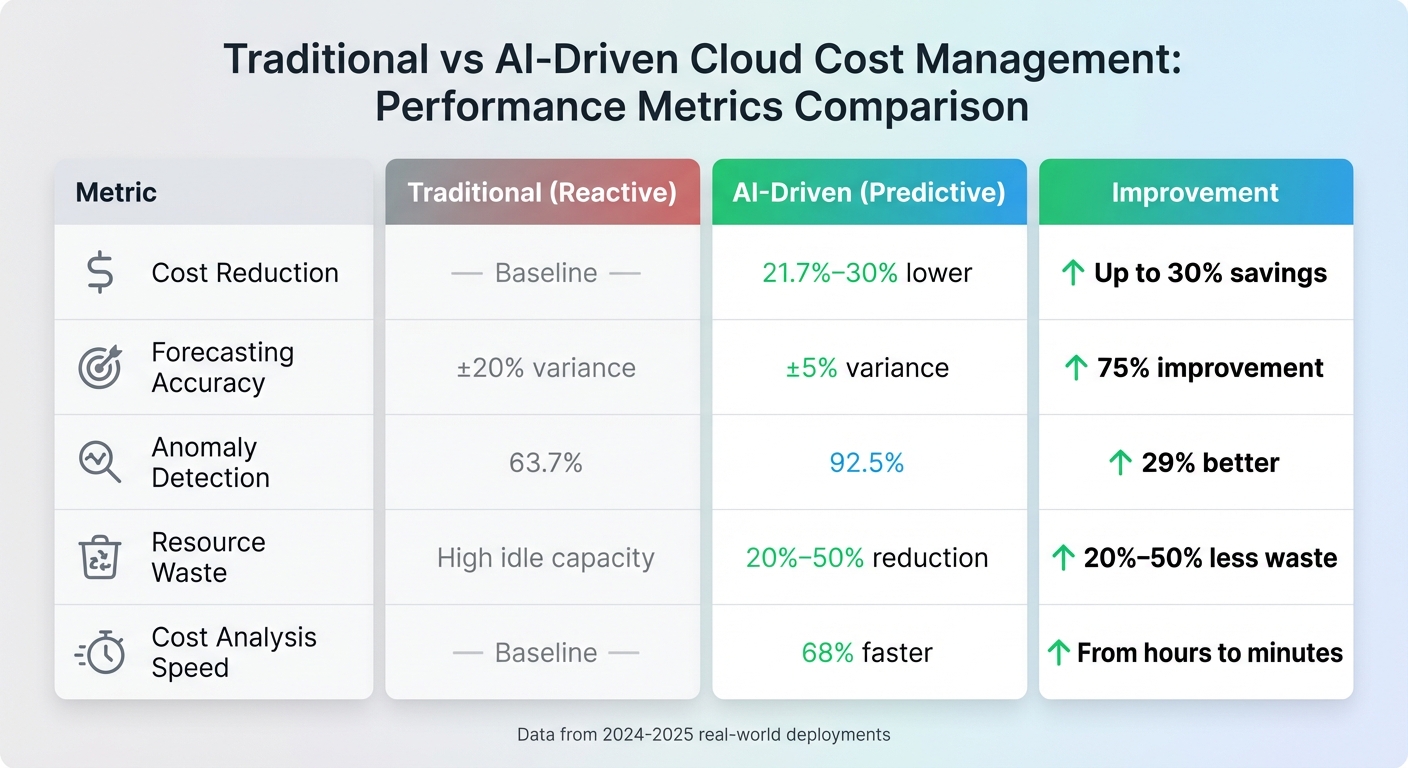
Traditional vs AI-Driven Cloud Cost Management: Performance Metrics Comparison
When using predictive strategies, the real impact often lies in the numbers. To truly grasp the financial benefits, you need to measure improvements in three key areas: efficiency (how effectively resources are utilized), cost (direct financial savings), and performance (ensuring that optimizations don’t create new issues). A focus on unit economics – like cost per request, user, or operation – helps reveal the actual savings achieved.
Switching from reactive to proactive cost management can bring significant, measurable results. For instance, between January and June 2025, KnowBe4 implemented autonomous AI systems under the leadership of Matt Duren, VP of Software Engineering. In just five months, they reduced production costs by 50% and achieved an impressive 87% savings in development environments by automating resource scaling and removing manual processes. Similarly, Palo Alto Networks, guided by SVP of Engineering Suresh Sangiah, cut Kubernetes-related costs by 46%, saving $3.5 million annually, thanks to AI-driven optimizations.
Before and After Metrics Comparison
The table below highlights the typical improvements organizations experience after adopting predictive insights. These figures are drawn from real-world deployments across various industries during 2024–2025:
| Metric | Traditional (Reactive) | AI-Driven (Predictive) | Improvement |
|---|---|---|---|
| Cost Reduction | Baseline | 21.7%–30% lower | Up to 30% savings |
| Forecasting Accuracy | ±20% variance | ±5% variance | 75% improvement |
| Anomaly Detection | 63.7% | 92.5% | 29% better |
| Resource Waste | High idle capacity | 20%–50% reduction | 20%–50% less waste |
| Cost Analysis Speed | Baseline | 68% faster | From hours to minutes |
These results stem directly from the strategic approaches discussed earlier. For example, More Retail slashed peak capacity costs by 40%, dropping monthly expenses from $5,000 to $3,000, by incorporating predictive demand forecasting into their infrastructure systems. Such tangible savings reinforce the value of adopting AI-driven cost management practices.
Conclusion
Predictive insights are reshaping the way technical teams handle cloud spending. Instead of waiting for bills to arrive and reacting afterward, machine learning models now enable teams to forecast demand, pinpoint inefficiencies, and adjust resources automatically in real time. This proactive approach helps prevent overspending and drives both cost savings and operational efficiency. By shifting from reactive reporting to smarter, forward-thinking strategies, teams can focus less on manual tracking and more on delivering innovations that generate revenue.
Organizations adopting these advanced forecasting methods see measurable improvements in accuracy and reliability compared to older techniques. The result? Companies frequently achieve reductions of 20–30% in cloud costs while maintaining – or even improving – performance. Eliminating over-provisioned instances, shutting down idle resources, and scaling capacity before it’s needed not only trims expenses but also builds a leaner, more efficient infrastructure.
This shift reflects the mindset needed for today’s cloud management:
"The goal of forecasting is not to predict the future but to tell you what you need to know to take meaningful action in the present."
- Paul Saffo, Forecaster and Adjunct Professor, Stanford University
To lock in these savings, it’s essential to take actionable steps that align cloud spending with your business goals. Start by gathering historical usage data, leveraging machine learning for cost forecasting, monitoring real-time anomalies, and automating decisions like rightsizing. Each of these efforts builds on the last, creating compounding savings and allowing your engineering team to focus on high-impact projects instead of tedious cost management.
FAQs
How do predictive insights help minimize idle cloud resources and lower costs?
Predictive insights use past usage patterns to anticipate future demand, allowing systems to automatically manage resources. This might mean scaling down or even shutting off underused instances, ensuring resources are active only when they’re truly needed.
By cutting out idle cloud resources, businesses can trim unnecessary costs while still keeping performance and efficiency at their best. This forward-thinking method ensures resource usage stays in sync with actual workload needs.
How does AI-driven cloud cost management differ from traditional methods?
Traditional cloud cost management tends to be reactive. It often depends on manual monitoring, basic auto-scaling that kicks in only after demand spikes, and scheduled shutdowns for idle resources. These methods typically use static rules or past billing data, meaning they address inefficiencies after the waste has already occurred.
In contrast, AI-driven cost management takes a proactive and predictive approach. By leveraging machine learning, it analyzes historical usage patterns, real-time telemetry, and critical business metrics to forecast demand, spot anomalies, and optimize resources automatically – before overspending becomes an issue. This shifts cost management into a continuous, data-driven process.
TECHVZERO applies these advanced predictive techniques to automate resource optimization, remove the need for manual cost-control tasks, and deliver real savings for U.S. businesses. The result? Faster, more reliable deployments with less effort.
How can machine learning help forecast and reduce cloud costs more accurately?
Machine learning improves cloud cost forecasting by diving deep into historical data – examining usage patterns, pricing fluctuations, and infrastructure adjustments. It goes beyond surface-level analysis, spotting seasonal trends and workload behaviors, while also dynamically updating predictions to match real-time conditions.
This method provides far more accurate cost estimates than traditional manual or rule-based approaches. With these insights, businesses can take control of their budgets, trim unnecessary expenses, and make smarter decisions to maximize efficiency in their cloud spending.